State of European Tech 2025

02

Europe's Talent Engine

This chapter explores Europe’s deep and dynamic tech talent base — one which is expanding fast, rich in technical excellence, and driven by founders who see building in Europe as part of their mission. Optimism is returning and the entrepreneurial pipeline is stronger than ever, but scaling friction and perception risk remain real. The task ahead? Turn Europe’s talent advantage into an enduring global edge by making it the best place in the world to build and scale.

Europe's talent has all the ingredients

It’s a good time to start a company in Europe

The conditions for starting a company in Europe are improving, say our survey respondents. When we asked how attractive it is to become a tech founder in Europe right now, 42% said it's more attractive today than a year ago.

This is a significant increase compared to previous times we have asked the same question. In both 2023 and 2024, only around a quarter of our survey respondents agreed that conditions for starting a company had improved, with more saying things were actually getting worse.

Optimism is highest among VCs and LPs, who typically have a bird’s-eye view of the factors that smooth, or add friction to, the experience of entrepreneurship. Sentiment has materially improved among founders too, with the share of those feeling positive increasing from 25% to 33%, and the share of detractors falling by almost half.

How attractive do you think it is to become a founder of a European tech company now compared to 12 months ago?

SOET Logo

Source:

Notes:All respondents.

Europe’s tech talent pool continues to expand

In this year’s analysis, we looked specifically at employees based in Europe, regardless of their employer’s headquarters location. This is a refinement of previous editions, which classified tech talent by their company's incorporation. The updated approach provides another view into Europe’s tech workforce — where it actually sits and how much of it is contributing to locally headquartered startups and scaleups.

Our tech workforce is growing from a smaller base but catching up fast — more than doubling since 2016. Over the past decade, headcount has risen at a compound annual growth rate of 9.1% to reach 4.6M.

Interestingly, the Europe-based tech workforce is also increasingly working for European tech companies. It has now grown to around 3M, compounding at a rate of 10.1% annually over the past decade (versus 7.5% for non-European headquartered companies), and now represents 65% of the total European tech employee base. This is up from 59% in 2016 as the number and scale of homegrown champions has expanded across the region.

Senior talent — which includes those working as managers, team leads, and department or function heads — is scaling too. From 2016 to 2025, Europe’s pool of senior tech employees has almost doubled, growing faster than the US from a smaller base. The US still has the larger bench, but the gap is narrowing as Europe’s scaleups mature and digitising incumbents create more executive roles.

What’s striking is that this expansion has continued despite heightened debate over AI-driven job disruption. Rather than shrinking, Europe’s tech employment base keeps widening — reflecting strong demand for AI, data, and software talent across all industries.

Count of Europe-based and senior tech employees (M) by company HQ and region, 2016 to 2025

SOET Logo

Sources:

Notes:Data is as of 30 September 2025. Location is based on where a person is based. Senior tech employees are defined as those who hold Leadership, VP/SVP, Director/Head of and Manager/Team Lead positions at tech companies.

Getting more talent onto rocket ships

Startups and scaleups are Europe’s engines of growth and innovation, capturing a growing share of the talent pool. Still, we do have a majority working elsewhere — in large corporates, consultancies or the public sector.

Europe’s most mature ecosystems, such as the UK, France, and Germany, reflect decades of investment in tech and as such have created deeper talent pools. A few countries like Finland, Iceland, Ireland, and Estonia, for example, where VC-backed tech companies hire 50 to 65% of all roles, tend to have smaller, tighter tech scenes.

Overall, almost half (47%) of the roles working in European tech are based in VC-backed companies. This share has grown significantly over the last decade, from just 38% in 2016. We can expect this expansion to continue as more capital becomes available and as the current cohort of VC-backed companies matures.

Share (%) of roles in tech companies split by VC backing status for select countries and regions, 2025

SOET Logo

Sources:

Notes:Data is as of 30 September 2025. Location is based on where a person is based.

📢 European talent powering innovation

47%

of European tech employees now work for a VC-backed company (versus 38% in 2016).

Sources:

I spent a decade at Google in the Bay Area. When I came back to Europe, I expected hiring to be brutal. It wasn't.

Take Zurich—easily Europe's most underrated tech hub. Thousands of Big Tech engineers already live here. Google's here. OpenAI and Anthropic both have research hubs. ETH and EPFL pump out world-class talent. And the best part? The US talent pool is so hyper-competitive that comp differentials stretch startup runways 2-3x. Your burn rate in Zurich versus San Francisco is not even close. Retention is stronger too, which matters enormously in ML where effective onboarding takes 9-12 months. For us as a biotech company, being a short train ride from Roche and Novartis doesn't hurt either.Is everything perfect? No. Finding experienced scale-stage executives is tough. But that's fixable. Europe has a talent advantage. Now we need to turn it into a real scaling edge.

Stef van Grieken

Co-founder & CEO, Cradle

Europe rivals the US on engineering talent

Europe may still employ fewer people in tech overall than the US, but it’s closing the gap quickly. When it comes to technical talent — engineers, developers, data scientists, CTOs, and other core roles — the divide is even narrower than for the total tech employee base.

In 2025, Europe counts 2.7M technical or engineering employees, or 1M fewer than the US, and is in fact growing faster: 11.2% annually versus 8.2% across the Atlantic.

Count of technical and software engineering employees (M) working in tech or non-tech industries in Europe versus United States, 2016 to 2025

SOET Logo

Sources:

Notes:Data is as of 30 September 2025. Location is based on where a person is based.

👩‍💻 Europe boasts a strong technical DNA

8.5%

of engineers working for deep tech companies have a PhD — higher than the US (7.4%). Switzerland in particular stands out, peaking at 18%, reflecting its exceptional academic leadership in AI.

Sources:

Building from Spain has shown us that top global talent will come when the mission and the tools are world class.

As a company deeply rooted in Europe’s innovation ecosystem, Multiverse Computing embodies the continent’s values of collaboration and scientific excellence. Our partnership with AWS strengthens our ability to scale these principles globally showcasing how European startups can lead the world in building efficient, accessible, and sustainable AI models.

Enrique Lizaso

Co-founder and CEO, Multiverse

Entrepreneurial mindset is taking off again

Entrepreneurship in Europe has surged over the past two years. The number of people starting companies in 2025 is nearly 59% higher than in 2023, surpassing even the highs of 2021.

Europe continues to lead globally in the number of new founders, even as the US sees its own wave of entrepreneurial growth, up 63% over the same period.

What we are witnessing is a global uptick in company building, fuelled by lower barriers to entry, from no-code tools and open-source infrastructure to stronger founder networks, and by a powerful market pull in the age of AI. Founders sense a paradigm shift that opens the door to building generational companies.

The real test lies ahead. Europe has proved it can create companies at record pace. The question now is how many of these startups can scale into enduring businesses. That will require doubling down on the infrastructure that sustains growth: deeper pools of follow-on capital, cross-border mobility of talent, and smarter policy that makes scaling from Europe to the world easier.

This surge is not just a rebound — it is a window of opportunity. The momentum is there. Europe’s challenge is to ensure this generation of founders has the runway to build globally competitive companies that last.

Count of unique founders (k) starting companies, 2016 to 2025

SOET Logo

Sources:

Notes:Data is as of 30 September 2025. To adjust for lags in reporting, we compare snapshots of data at different points in time, which allows us to estimate future growth of current figures by extrapolating differences between time points. Both 2024 and 2025 data are forecasted by adjusting for reporting lag and by extrapolating data as of September 2025.

The global talent race is tightening

New hubs are emerging around the world, and the number of locations where it’s viable to start and grow a global tech business is rising fast.

Europe has maintained a steady near-30% share of the world’s founders over the past decade, underscoring that it has long proven its ability to create new companies. The challenge now lies not in starting them, but in scaling them to global success.

It’s worth noting that China isn’t included in our calculations due to the lack of reliable data — but even then, Asia’s share has climbed to 28%, up from 22% a decade ago. Within Asia, India has seen the steepest rise: its founder base has grown at a 5% CAGR since 2016, now accounting for 58% of the region’s total. The UAE is also contributing more founders than ever, with 10,000 more today than a decade ago, representing over 6% of Asia’s founders — up from 3% in 2016.

Competition is heating up — and Europe must move decisively if it wants to retain its position as one of the world’s most attractive places to build.

Share (%) of global founders starting companies by region, 2016 and 2025

SOET Logo

Sources:

Notes:Data is as of 30 September 2025. To adjust for lags in reporting, we compare snapshots of data at different points in time, which allows us to estimate future growth of current figures by extrapolating differences between time points. 2025 data is forecasted by adjusting for reporting lag and by extrapolating data as of September 2025.

Europe was the perfect place to start our company for many reasons.

The ecosystem has matured so much, and there is capital here. Most importantly, there is incredible talent here that's very unique in the world, specifically for robotics, for AI, for research on that side. Europe has an incredible talent pool. It's true that all these people don't all live in the same city, and that's totally fine, but the diversity of ideas, opinions, and stuff that has been built all over Europe was a key component of why we decided to [be based] here.

Tomaz Stolfa

Co-founder/CEO, Sunrise Robotics

Building from Europe – a shared ambition

For most European founders, building a company is about more than the business itself. It is also about proving that world-class companies can be born and scaled in Europe.

In our survey, 51% say building in Europe is part of their mission. A further 34% prefer to build from Europe, while recognising their company’s needs may require a move. Only 15% are geography-agnostic and focused solely on scaling wherever is fastest.

What these founders are telling us is clear. If Europe wants to keep its founders, it must make sure they do not feel constrained in their scaling journey by local operating conditions.

Do you feel a sense of mission to build and scale your company in Europe, even if it might be harder than elsewhere?

SOET Logo

Source:

Notes:Founder respondents only.

Talent market dynamics

Access to top-tier talent is improving

Positive sentiment towards entrepreneurship is rising throughout the ecosystem, making it easier for startups to attract experienced talent. Forty percent of respondents to our survey say it’s become easier to recruit and retain top-tier talent over the past year — the highest level ever in the past five years.

It's been a tough few years for the talent market, as tech companies laid off staff following a period of market correction. As those pressures have eased, talent supply has rebounded and operator roles are once again seen as a smart career move.

In your opinion, is it easier or harder to recruit and retain top-tier talent in Europe than it was 12 months ago?

SOET Logo

Source:

Notes:Founder, co-founder, operator at a startup or scaleup respondents only. Respondents who selected “do not know / unable to comment” are excluded from the data. Numbers may not add up to 100 due to rounding.

The best European founders now see equity incentives as a strategic tool — not just a reward mechanism.

Getting incentive plans right is crucial to attracting and retaining the kind of talent that can scale globally from a European base. That means thinking early about alignment, transparency, and simplicity — ensuring employees understand both the value and the pathway to liquidity. We’re helping more companies design plans that are competitive across borders, and it’s clear that those who get this right create stronger, more committed teams for the long run.

Rebecca Servian

Partner, Orrick

Europe continues to be a magnet for tech talent…

Europe is an attractive place to pursue a career in tech, as demonstrated by its continued ability to lure more tech talent from abroad than it loses. This has been a consistent feature of the ecosystem across the years covered by our data — but since 2022, the influx has started to flatten. While 52k more people arrived to work in European tech than left in 2022, that number is down to 26k in 2024.

This is not a uniquely European phenomenon: the US is experiencing a similar trend line, with net talent migration in 2022 at 48k while in 2024 it dropped to 29k. These slowdowns have been largely driven by a reduction in talent arriving from India, reflecting the country’s smaller overall net migration outflows in 2024.

Breaking down net migration by country, Europe still loses more tech talent than it gains to the US, Canada, and Australia — its closest competitors for builders and innovators. Yet, the trend is beginning to shift. After hitting a low point in 2022, migration flows between Europe and the US are moving back toward parity, suggesting Europe’s appeal as a place to build and scale is recovering.

Net talent inflow (k) migrating to work in European tech, 2016 to 2024

SOET Logo

Sources:

Notes:Data is as of 30 September 2025. Location is based on where a person is based. Inflow measured as employees joining tech companies only, but could have previously worked at either non-tech or tech companies.

…but attracting and keeping senior talent is a critical battle

While Europe is a net beneficiary of talent overall, it is edging towards zero when zooming in on senior talent. In fact, we mapped nearly 1k senior employees leaving Europe moving abroad to work for Amazon, Google, Microsoft, Meta, and TikTok alone.

Many seasoned leaders are heading to the US and UAE in particular, the former having long lured senior talent with higher pay and generous equity schemes, and the UAE now increasingly positioning itself as a tax-free, business-friendly haven for executives. The US follows a similar downward trend from 2022, but in absolute terms it still ended net positive by roughly the same margin as Europe (3.5k versus 2k). Country composition-wise, the trends are strikingly similar — the top sources of senior talent migrating into the US are India, the UK (which is trending upwards), and Australia.

But with tightening visa policies, trade uncertainty, and political unpredictability in the US, senior leaders might be turning their attention back to Europe, creating a momentum that may well be reflected in the numbers for 2025.

Europe is losing precious know-how and networks that senior talent build up through their careers, which are essential for scaling globally competitive companies.

To capitalise on this opportunity, it must focus on retaining and attracting such leaders by offering comparable rewards — both financially and in terms of career-defining opportunities — to its global rivals.

Senior net talent inflow (k) migrating to work in European tech, 2016 to 2024

SOET Logo

Sources:

Notes:Data is as of 30 September 2025. Location is based on where a person is based. Inflow measured as employees joining tech companies only, but could have previously worked at either non-tech or tech companies. Senior is defined by employees who are at levels of being Team Leads, Directors, Vice Presidents, to C-Suite / Founders. Excludes all China data.

Visa velocity: Europe’s untapped advantage

One way for a country to expand its tech talent pool is through visa schemes designed to attract skilled workers. The US’s H-1B visa is one well-known example, allowing companies to hire top talent who can bring their families with them when they relocate.

The US hands out 85k new H-1B visas per year and renews many more — but the introduction of a $100k application fee has opened the door for Europe and other tech hubs to attract talent now looking beyond the US.

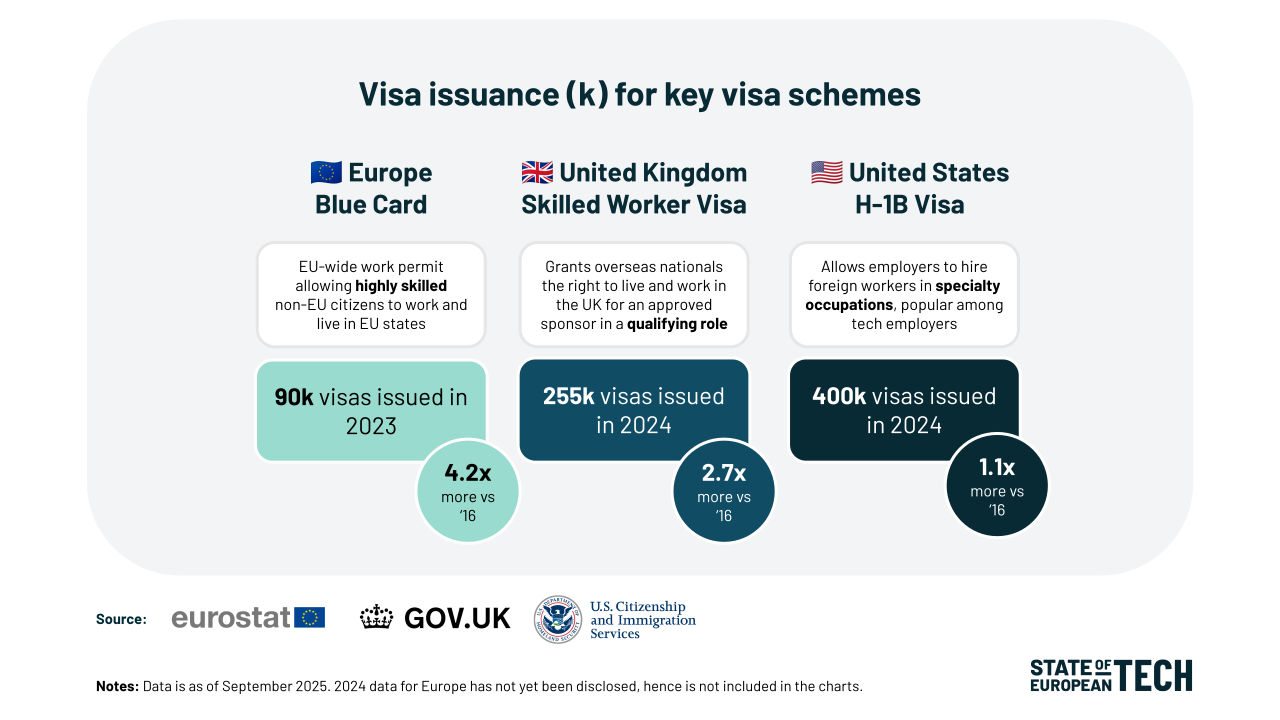
The UK has ramped up Skilled Worker visas, from around 100k annually before 2020 to nearly 500k by 2023, driven by a post-Brexit system where EU nationals must now get visas, as well as a wider reshaping of eligibility rules. Last year, 255k visas were issued after salary thresholds were increased. The UK's Global Talent visa, which allows highly skilled workers to apply without a job offer, has endorsed over 5.2k applicants since 2014 — with one in four being founders.

Other European countries, meanwhile, are still far behind the US and the UK in attracting global talent through flagship visa programmes. In 2024, the US issued 400k H-1B visas and the UK issued 255k Skilled Worker visas. In 2023 (the latest numbers available), Europe issued just 90k Blue Card visas, which targets skilled professionals wanting to live and work in EU member states (excluding Denmark and Ireland).

Still, Europe has made progress. Its Blue Card scheme issued 4.2x more visas in 2023 than it did in 2016. Visa issuance numbers also do not account for free movement within the EU, which allows skilled workers to relocate without needing a visa.

Visibility into how many of these visa holders work in tech is limited, but these schemes represent major channels for attracting international workers. As the global battle for talent heats up — particularly in sectors like AI, fintech, and deep tech — Europe will need to match the scale of visa programmes run in the UK or US.

The founder flight debate

Europe is losing some top founders to the US — but most stay

There is a common perception that most of Europe’s best founders are leaving for the US — but the data tells a much more nuanced story. The strong majority of founders still choose to build and scale their companies from within Europe.

To better understand the underlying dynamics, we segmented the data into two subgroups. The first comprises seasoned founders — those who have held C-suite roles in a set of leading tech companies. The second focuses on AI founders, given the heightened competition for talent and capital in this sector.

Across all founders, more than 80% continue to build from Europe, a trend that has remained stable since 2016. In fact, the share of European founders who chose to headquarter their companies in the US has slightly declined — from 10% in 2016 to 8% in 2025. The trend is even more positive among AI founders, with 81% now building from Europe, up from 74% in 2016. Founders are betting on Europe — more so than a decade ago.

However, when we look more closely at European seasoned founders defined based on their first work experience location being in Europe, an interesting picture emerges. Among those who started their companies in 2016, 10% of seasoned founders had headquartered their startups in the US. In 2025, this almost doubled to 18%. While this doesn’t always mean they personally relocated, it does suggest at the very least an increased preference to incorporate in the US — where company formation is faster, cheaper, and often a gateway to US customers and investors.

What's also worth noting is the hidden opportunity in these numbers. These founders had often left Europe long before. In fact, 42% of the 2016 cohort and 56% of the 2025 cohort had already been gaining experience abroad — often in the US — for more than a decade. Only 36% and 33% respectively (or 4% and 6% overall), are founders who have left Europe in the past three years. This distinction matters: it suggests that a meaningful share of the “outflow” of experienced founders reflects an older generation who left when Europe’s ecosystem was still maturing, not simply a recent exodus.

This highlights the challenge to retain founder talent, but the nuance also reframes the challenge as a latent opportunity. Europe now has a diaspora of highly skilled, globally connected founders who left when the ecosystem was still young — and who could play a catalytic role if attracted back. The goal should not only be to retain founders, but also to re-engage those who once left.


Share (%) of European-origin founders by type, founded company's HQ region and founding year, 2016 to 2025

SOET Logo

Sources:

Notes:Data is as of 30 September 2025. Founder origin is determined by their first country of employment. Seasoned founders are defined as those who have previously created companies or held C-suite positions at leading tech companies or raised significant amounts of capital in past ventures.

The energy is back in Stockholm.

Momentum has been ramping up the past 18 months and founders are more ambitious than we’ve ever seen. There’s a genuine belief that generational companies can be built here in Sweden, especially in AI, and that’s certainly getting us noticed.

I think our founders have an approach to building products that is deeply rooted in our culture here: a balance of simplicity, good taste, and practicality that helps create products that people can care deeply about. Which is why I’m not at all surprised that we’re witnessing yet another major technological leap where we have Swedish founders emerging as global leaders.

I hope what’s happening here gives confidence to founders across Europe. Even with more regulatory friction and less local growth stage capital than in comparison to the US, it’s absolutely possible for European companies to compete - and win - on the global stage. More than 65 European cities are now home to at least one billion dollar valued business, up from only three in 2010. Where you start now has much less of an impact on how far you can go.

Fredrik Cassel

General Partner, Creandum

Most founders are staying put

To give another perspective, we posed the same question to founders taking this year's State of European Tech survey. From our survey respondents, only around 15% of founders have relocated, roughly aligned with our analysis in the chart above where 18% of founders were building their companies outside of Europe.

What is concerning is that over 40% of respondents said they have considered moving their business. Relocation tends to be concentrated among later-stage and more experienced teams. About 23% of Series B+ stage survey respondents and a similar share of repeat founders have moved, compared with just one in ten first-time or bootstrapped founders.

Perception plays a key role. Founders who view Europe’s regulatory environment as restrictive are significantly more likely to move than those who see it as supportive. The data points to friction, not ambition, as the trigger — suggesting that it’s regulation, access to growth-stage capital, and credible exit pathways that determine whether Europe’s best companies stay and scale at home.

Have you ever moved — or seriously considered moving — your company’s headquarters to another country?

SOET Logo

Source:

Notes:Founder respondents only.

The US still has an allure for founders, but Europe is not far behind

We asked founders who have relocated or are considering relocating where their top destinations are, and when aggregating across its different regions and cities, the US comes out as the frontrunner, cited by over 70% respondents considering a move and also capturing the highest share of those who went through with it. The responses point not only to the funding gap between Europe and the US, but also to intra-European disparities that can hinder companies from reaching their potential.

Yet, founders are not ditching Europe. A continental move is almost equally attractive with 61% of respondents citing Europe as a destination they would consider moving their business to.

Which country or region did you move or consider moving to?

SOET Logo

Source:

Notes:Founder and co-founder respondents who either considered relocating or relocated only.

Access to capital is the strongest pull factor for relocating founders 

For founders who have relocated — or are considering doing so — there was a clear consensus on the main factor influencing that decision: access to capital.

Across the two groups, more than 60% of founders identified the need for greater access to funding as the primary driver behind relocation considerations, making it the most common response. This was even higher for founders considering a move, at 66%. Access to customers ranked second, with challenges related to the regulatory and operating environment following closely behind.

Digging a level deeper, the factors shaping relocation decisions vary according to a company’s size and stage. Series B founders were significantly more likely to point to investor pressure as an influential factor than their bootstrapped or Series A counterparts. By contrast, earlier-stage founders were more likely to cite regulatory hurdles as a key concern.

Meanwhile, larger and later-stage companies were more vocal about access to talent — reflecting both their ambitions for international expansion and the increasing complexity of scaling beyond their home markets.

What were the biggest drivers for considering relocating your tech company?

SOET Logo

Source:

Notes:Founder and co-founder respondents who either considered relocating or relocated only.

Startups want VCs to help them raise future funding

When asked where investors add the most value beyond capital, founders say support in raising their next round is what matters most. More than half of founder respondents identified this as their biggest need, reflecting how difficult it remains to secure follow-on funding as companies grow and their capital needs expand.

Investors largely agree, recognising next-round support as a key area where they can make the greatest difference. This alignment highlights the structural reality of a European market that is no longer about starting companies but about sustaining them through the scale-up phase.

That need extends beyond capital. Founders also highlighted the importance of introductions to potential customers and support in expanding into new markets. Scaling in Europe often requires looking beyond the continent, as startups face persistent challenges selling into large corporates or public-sector buyers at home. The most effective investors are those who can open both funding and customer pathways, helping founders secure the next cheque, the next buyer, and the next expansion market.

Beyond providing capital, what type of support from investors adds the most value to companies?

SOET Logo

Source:

Notes:Investors include venture capital, accelerator, angel, and growth tech investors. Showing top 10 responses only. Respondents were asked to select up to three options.

European startups head to the US first when scaling sales teams

When European startups scale their sales functions, the US remains their first and most important destination. A quarter of Series A companies hire their first non-domestic sales employee there, and nearly half of all non-local sales roles in later-stage startups are based in the US.

The pattern highlights both global ambition and constraint. Founders know they need to reach the US market early to scale revenue, but they also face structural hurdles at home, from a fragmented European market to low corporate appetite for buying from startups, despite more than $2T in annual IT spending across the continent.

For many founders, expanding internationally is not optional but essential to reach customers at scale. The US offers a single, high-value market and faster commercial adoption, making it the default launchpad for global growth for many European startups and scaleups. As Europe strengthens its access to capital, it must also work to strengthen access to demand, ensuring the next generation of European scaleups can build global sales engines from home, not just abroad.

Share (%) of first or all non-domestic sales employees hired by their location for European companies that have raised Series A since 2016, 2025

SOET Logo

Sources:

Notes:Data is as of 30 September 2025.

Scaling prompts European founders to expand abroad

A minority of European founders choose to base their headquarters abroad, and among those that do, around half head for the US. It’s a reflection of the country’s enduring appeal as a large-scale market with deeper capital markets. Silicon Valley and New York account for almost half of European founders with company headquarters now in the US.

This is also reflected in the capital journey as relocations become more common as companies grow. Around 18% of European-founded Seed-stage tech companies are based outside of the continent’s borders, but this number rises to around 30% by Series C and beyond.

Not all founders leap across the pond, though, with intra-Europe moves accounting for a large portion too. The UK is the second-most popular destination for founders looking to relocate (although still far behind the US), followed by a mix of smaller hubs across Europe, Asia, and the rest of the world.

Europe’s most successful companies are thinking globally from day one. The challenge now is convincing them they can do it all from here — and that the continent can attract late-stage capital at comparable levels to what they might find elsewhere.

Share of European repeat founders that have moved their HQ location, by new HQ location and by stage of funding, 2025

SOET Logo

Sources:

Notes:Data is as of 30 September 2025. Founder origin here is assumed based on their current location. Entries for founders are accepted when both their current location and company HQ location are disclosed.

🦄 Most unicorns stay in Europe

87%

of European origin $1B+ companies that are still headquartered in Europe today. Only 13% have relocated to the US during their scaling journey.

Source:

The European Commission rightly wants Europe to become the best place in the world to build and scale leading tech companies. But that vision won’t be achieved with half measures.

This continent doesn’t lack ambition or ideas, what it lacks is simplicity. For too long, founders have had to navigate 27 different systems just to raise capital, hire talent, and grow. To truly compete, we need to make it as easy to scale across Europe as it is in the US or China.

Sten Tamkivi

Partner, Plural

Europe’s got what it takes to build $100B+ companies

Europe has a deep and growing pool of tech talent to call upon. Most founders tell us they would prefer to keep scaling on the continent rather than move abroad. The question is whether Europe can supply the people needed to make that ambition real.

On balance, founders think it can. Fifty-three percent agree that European startups can attract and retain the talent needed to build the next $100B company. Confidence rises with scale: 60% at late stage, compared with 55% at early stage, and 52% among bootstrapped teams.

Outlook and experience shape the picture. Sixty-nine percent of Europe optimists agree, versus 29% of pessimists. Founders who have relocated are less confident (41%) than those who stayed (50%). Taken together, the message is clear: confidence grows as friction falls, which points to deepening senior talent pipelines, easing cross-border hiring, and aligning incentives that help companies hire and keep the best people at scale.

Can European startups and scaleups attract and retain the talent needed to build the next $100B tech company in Europe?

SOET Logo

Source:

Notes:Founder and operator at a startup or scaleup respondents only. Segments are defined by survey items on (1) HQ relocation (moved/seriously considered moving), (2) optimism versus 12 months ago about European tech, and (3) perceived change in ease of raising VC in Europe.

Europe has the talent, but still lacks the reflexes. Founders here think deeply, with too many still aiming for local parity instead of global leadership.

To build trillion-dollar companies, we need global ambition from day one, less fear of failure, and faster iteration in the open. The advantage we have is talent: deep technical skill, high ownership culture, and a privacy-first mindset that earns trust. The best teams treat constraints as design specs and use Europe’s trust-centric values as an edge, not a brake. Clearer, more predictable regulation would help them move faster.

Mati Staniszewski

Co-Founder, ElevenLabs

Call to action

Europe's talent won't wait — nurture it now

Europe’s tech talent base has never been stronger. It is deep, dynamic, and expanding faster than the US — driven by founders who see building in Europe as part of their mission. Optimism is returning, hiring conditions are improving, and the entrepreneurial pipeline is healthier than ever.

Yet too many founders and operators still face a system that slows them down. Europe remains harder to hire in, slower to relocate to, and more complex to move across than competing regions. Regulatory fragmentation and cross-border barriers make it too difficult to scale teams fluidly or to build truly pan-European champions.

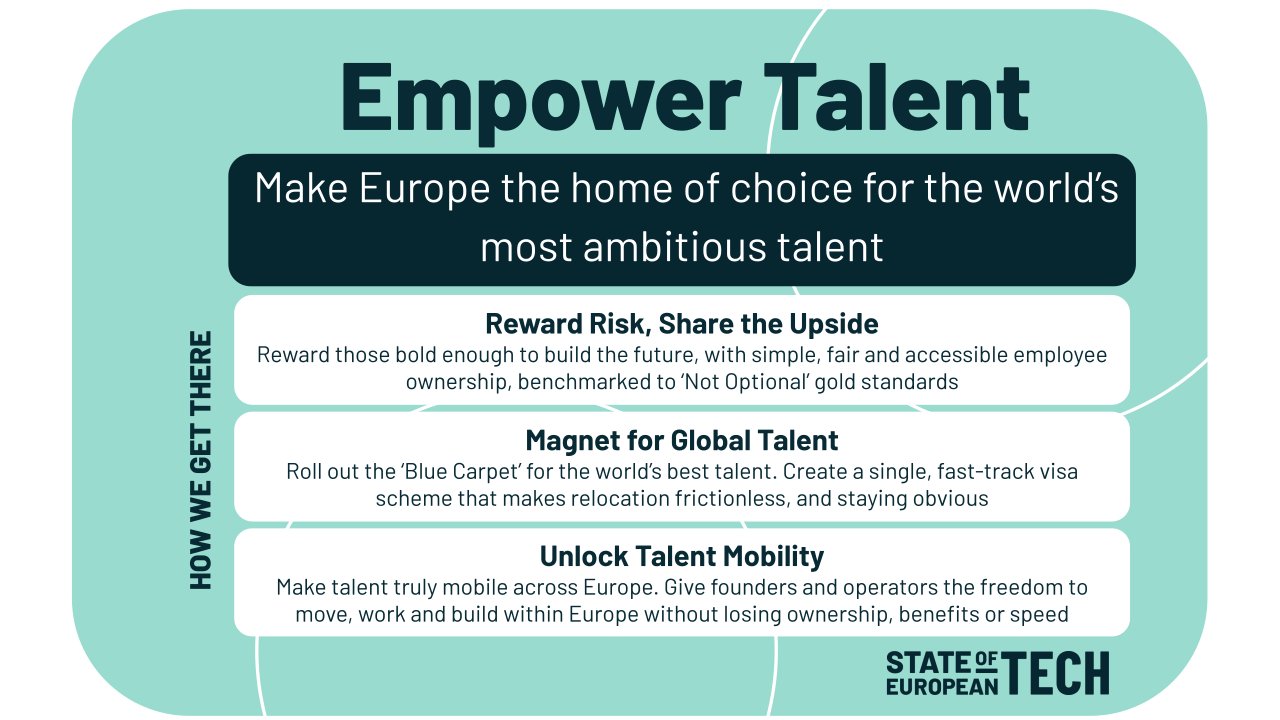
The urgent task ahead is to turn Europe’s talent advantage into an enduring global edge that makes Europe the home of choice for the world’s most ambitious talent. This means building an agile, borderless market for talent that makes it easier to hire, relocate and retain the world’s best builders, and by rewarding those bold enough to take the risk to stay and scale here.

How we get there:

  • Reward Risk, Share the Upside
    Reward those bold enough to build the future. Deliver long-overdue stock-option reform with a simple, fair and accessible framework benchmarked to Not Optional gold standards — ensuring every employee can share in the value they create.
  • Magnet for Global Talent
    Roll out the Blue Carpet for the world’s best builders. Create a single, fast-track visa and relocation framework that makes it frictionless for founders, operators and their families to come, contribute and stay.
  • Unlock Talent Mobility
    Make talent truly mobile across Europe. Give founders and operators the freedom to move, work and build within the continent without losing ownership, benefits or speed — by harmonising rules for tax, social security and recognition of experience.

Empowering Talent means giving people not just reasons to come, but reasons to stay, by rewarding risk, removing barriers, and making Europe the home of choice for the world’s most ambitious builders.

Next chapter →

Startup Investment Trends

Europe is producing more investable companies than ever — but funding levels are still catching up to support their scaling journeys. In this chapter, we explore the flow of investment into European tech companies and highlight where opportunities remain to bridge funding gaps.