State of European Tech 2025

01

Executive Summary

The continent’s tech ecosystem has reached a certain level of maturity, but long-term competitiveness depends on whether it can turn its promise into global strategic assets. Europe effectively stands at a crossroads. We don't lack talent or innovation — what Europe does lack is alignment between ambition and commitment.

Europe stands at a crossroads

Where are we going, Europe?

Our 2024 report charted Europe’s remarkable rise over the past decade to become a maturing ecosystem built on deep foundations. Since 2015, investment levels have grown more than tenfold, our talent base has expanded sevenfold, count of $1B+ has more than tripled and we now boast five $100B+ firms and ambition across the continent has never been higher. 

At the same time, we are entering the most transformative decades in human history. This next chapter will be written by those who can move fast and think long-term. Europe is perfectly positioned to lead, if we choose to. That choice requires speed, unity, and boldness. 


So the question is: what will define the next decade of European tech, and how do we take control of our future?

We want to equip builders and decision-makers with more than insights — we want to amplify a shared narrative to drive meaningful change. This year’s report does just that, focusing on the most urgent challenges and opportunities Europe must rally around today to define its future. Achieving these over the next decade could unlock trillions of dollars in GDP, millions of jobs, and even the future security of our continent.

A decade of growth in Europe

Europe's tech ecosystem has taken a huge leap forward, from being valued at less than $1T a decade ago to being now worth around $4T. Yet, its true potential is waiting to be unlocked. Where else in the wider European economy are we adding a trillion dollars of value in less than two years?

Private and public markets ecosystem value ($B), 2016 to 2025YTD

SOET Logo

Sources:

Notes:Private market data from Dealroom.co excludes the following: biotech, debt, and grants, as of 30 September 2025. Public markets data as per S&P Global Market Intelligence (Quantitative Research & Solutions), as of 24 October 2025, for illustrative purposes only. Values are based on companies headquartered in Europe.

📈 Europe's tech ecosystem represents

15%

of GDP, and has been trending upwards from 4% in 2016.

Sources:

Long on tech, long on Europe

European tech has a lot going for it, and industry-wide sentiment reflects that. Over the years, the community has reported increasing levels of forward-looking optimism, with our 2025 survey showing that 50% of respondents feel more optimistic than 12 months ago, compared to 34% in 2024. These are among the highest levels of optimism seen over the past decade.

But still, 50% is far from 100%, and despite all the growth and progress over the past decade, the tech community at large still has mixed feelings about Europe’s tech future. 

This is a sign of something structural. Europe hasn’t yet fully convinced its own stakeholders — founders, investors, and public and private funders — that it’s the best place to build world-leading companies. Collective confidence matters, and without it, even the boldest ambitions can only go so far.

Compared to 12 months ago, are you more or less optimistic about the future of European technology?

SOET Logo

Source:

Notes:All respondents.

European investment levels are on the rise again

The global startup funding environment has had a turbulent few years, and Europe is no exception. Investment levels are now on the rise once again, even if they remain well below the peak figures seen in 2021. Current data shows investment in tech startups is on track to finish at around $44B, suggesting that 2024 was the year funding truly bottomed out in Europe. 

As shown in the preceding charts, founder optimism and ambition continue to scale, but capital has yet to catch up to align firepower with global peers. Europe’s private markets remain too shallow, especially at growth stages. Late-stage rounds are smaller, scarcer, and slower than in other major ecosystems, and when companies then reach maturity, they face fragmented public markets that lack the depth and liquidity to sustain global ambition. Europe now needs a step change in its ability to mobilise growth capital at speed and scale, or risk losing momentum just as it has been ignited.

Total capital invested ($B) in Europe, 2016 to 2025

SOET Logo

Sources:

Notes:Data is as of 30 September 2025. Early-stage funding defined as rounds below $15M, late-stage funding refers to rounds of $15M and above. Full year 2025 extrapolated based on year to date data. Excludes the following: biotech, debt, lending capital, and grants.

Introducing the scorecard

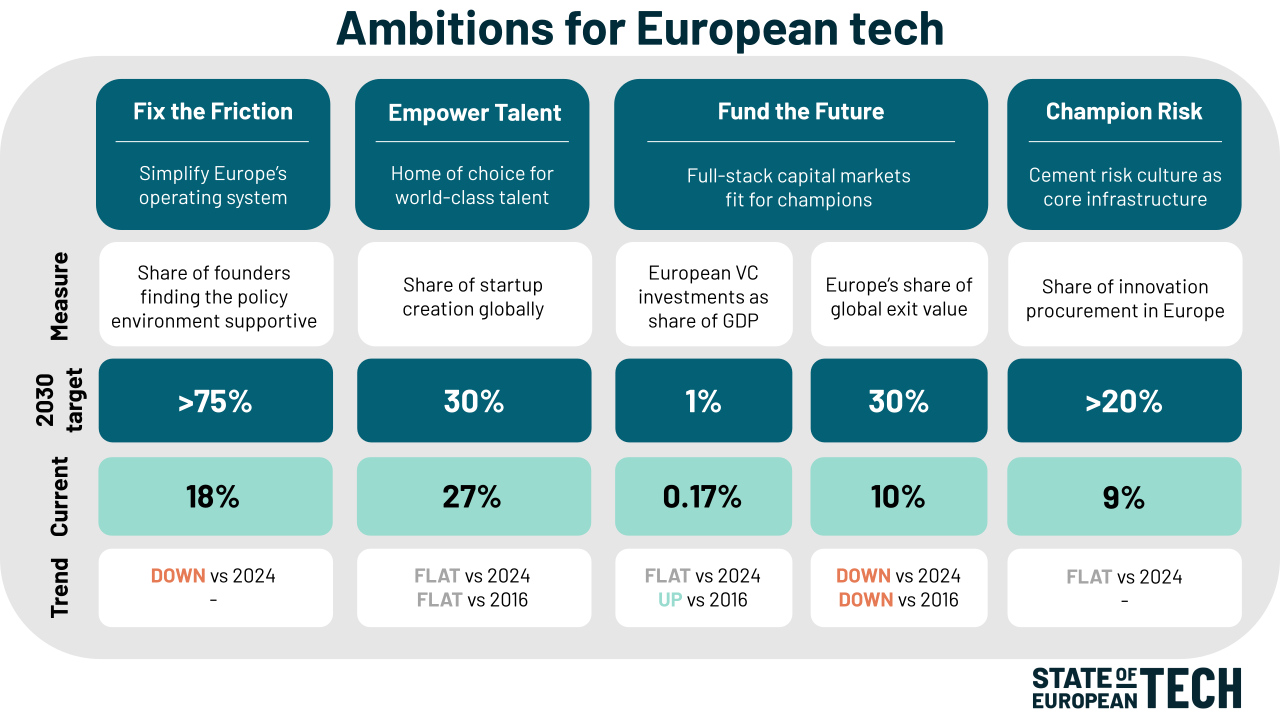
We need to start measuring the ambition for European tech

A founder wouldn’t run a business without monitoring its key health metrics, and the same approach should be taken to Europe’s wider tech ecosystem. To that end, we have devised the European Tech Scorecard — a simple, visual snapshot of where Europe leads, where it lags, and where it needs to go. 

While there are many indicators that matter, we’ve focused on four core drivers of long-term success that determine whether Europe is delivering on its tech promise, or leaving trillions in future, unrealised GDP on the table. Each metric is ambitious, measurable, and designed to be tracked year after year. The Scorecard is a tool to monitor progress, and see where collective action will have the greatest impact.

We cannot accept that our most talented may have to leave in order to thrive.

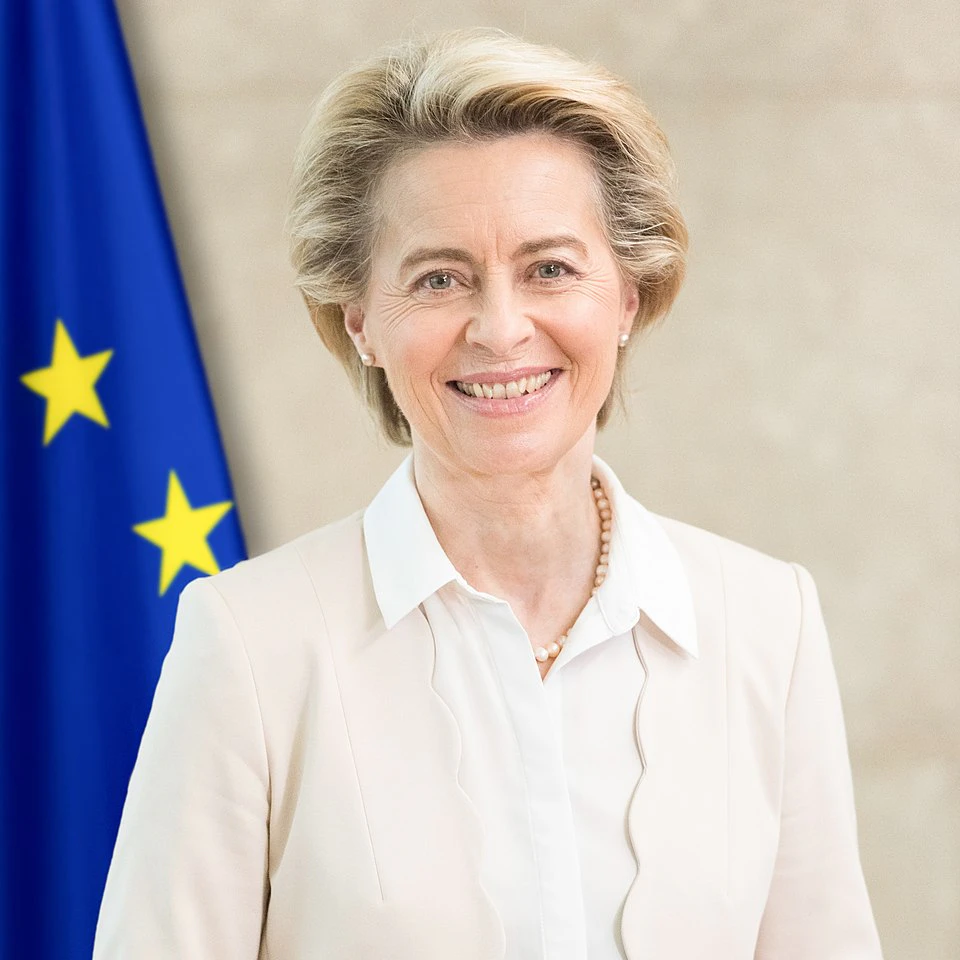
They must find the right soil to flourish here in Europe. I want Europe to be worthy of them. I believe that my job is to create the best conditions for talent to thrive, right here in our continent. This is the mission that drives me every day. I want the best of Europe to choose Europe. And I want the future of AI to be made in Europe.

Ursula von der Leyen

President, European Commission

Fix the friction

Europe’s operating system is overdue an upgrade

Europe's operating environment is too restrictive, say 70% of founders we surveyed. From Spain to the Netherlands to Germany, frustration is mounting as complexity holds back innovation and optimism alike.

Policymakers agree — but the pace of change is slow. The European Commission has promised to create a “28th regime” allowing startups to scale across the continent, but it’s not yet confirmed if this will be a Regulation or a Directive. This is the difference between having teeth or not, with the latter representing a continuation of the status quo where rules can be interpreted country to country, instead of the uniformity tech companies need to thrive.

Thousands of founders, investors and ecosystem leaders have spoken up, with more than 15,000 people already having signed EU–INC’s petition to get the Commission moving on its promise, joining consultations and organising pan-European awareness campaigns to call for a single, simple, framework that lets startups compete without legal friction.

Europe is now at a crossroads. The will is there, but can the legislation needed to fix the friction follow?

In your view, is the regulatory environment supportive or restrictive of European tech?

SOET Logo

Source:

Notes:Investors include LP, VC, and angel investors. Builders includes founders, co-founders, and operators at startups. Optimism refers to the response given to the question "Compared to 12 months ago, are you more or less optimistic about the future of European technology?".

The policy barriers holding the ecosystem back

It’s overwhelmingly clear what the ecosystem needs. Fifty percent are calling for the end of the market fragmentation, unencumbered access to capital markets, and changes to taxation. Policymakers themselves are indexing strongly on the top two — but show less appetite to reform taxation and employment and labour regulations, even though nearly one in three respondents overall rank these as a high priority.

Thinking of the regulatory environment, which are the top three most significant barriers to starting and/or scaling a technology company from Europe today?

SOET Logo

Source:

Notes:All respondents excludes policymakers.

Empower talent

Entrepreneurial mindset is taking off globally

Europe has long been a launchpad for bold ideas and new founders. The race for innovation is accelerating everywhere, and in Europe it has exploded.

In 2025, almost 60% more people in Europe started companies than in 2023. At 27,000+, this is the highest number of founders starting new ventures in Europe than any other year. Lower barriers to entrepreneurship — from no-code tools to stronger founder networks — have opened the door for a new generation of builders across all age groups.

Count of founders (k) starting new companies, 2016 to 2025

SOET Logo

Sources:

Notes:Data is as of 30 September 2025. To adjust for lags in reporting, we compare snapshots of data at different points in time, which allows us to estimate future growth of current figures by extrapolating differences between time points. Both 2024 and 2025 data are forecasted by adjusting for reporting lag and by extrapolating data as of September 2024.

The world is catching up fast

Europe still holds the edge when it comes to the total number of founders who call it home, but momentum is shifting. The continent remains just ahead of the US in terms of the share of the world’s founders it contributes, while Asia has caught up to now host an equally large share (28%). This is led by rising founder headcount in India and the UAE, both of which have more than doubled their founder bases in the past decade.

Share (%) of global founders starting companies by region, 2016 and 2025

SOET Logo

Sources:

Notes:Data is as of 30 September 2025. To adjust for lags in reporting, we compare snapshots of data at different points in time, which allows us to estimate future growth of current figures by extrapolating differences between time points. 2025 data is forecasted by adjusting for reporting lag and by extrapolating data as of September 2025.

We need to stay competitive to retain future talent

Over the past decade, European founders have become more likely — not less — to build their companies from Europe. Today, around four in five European founders are building on home soil, a share that has trended positively since 2016, and even held firm in the past year. Among AI founders specifically, the share building on the continent has actually increased from 74% to 81%. Europe remains the launchpad of choice for the overwhelming majority of founders.

But sustaining that momentum requires focus. When we look more closely at European seasoned founders, defined based on their first work experience location being in Europe, an interesting picture emerges. Among those who started their companies in 2016, 10% of seasoned founders had headquartered their startups in the US. In 2025, this almost doubled to 18%. While this doesn’t always mean they personally relocated, it does suggest at the very least an increased preference to incorporate in the US — where company formation is faster, cheaper, and often a gateway to US customers and investors. To counter that, Europe must become the most compelling place in the world to build a generational company. Every founder that leaves because they see brighter prospects outside of Europe is one too many.

Europe’s next wave of outlier founders — from Synthesia, n8n, and Framer to Lovable, DeepL, and ElevenLabs — are showing that it can be done, proving that world-class innovation doesn’t need to leave Europe to scale globally. But they shouldn’t have to do it in hard mode.

Share (%) of European-origin founders by type, founded company's HQ region and founding year, 2016 to 2025

SOET Logo

Sources:

Notes:Data is as of 30 September 2025. Founder origin is determined by their first country of employment. Seasoned founders are defined as those who have previously created companies or held C-suite positions at leading tech companies or raised significant amounts of capital in past ventures.

Fund the future

Firepower to fuel ambition

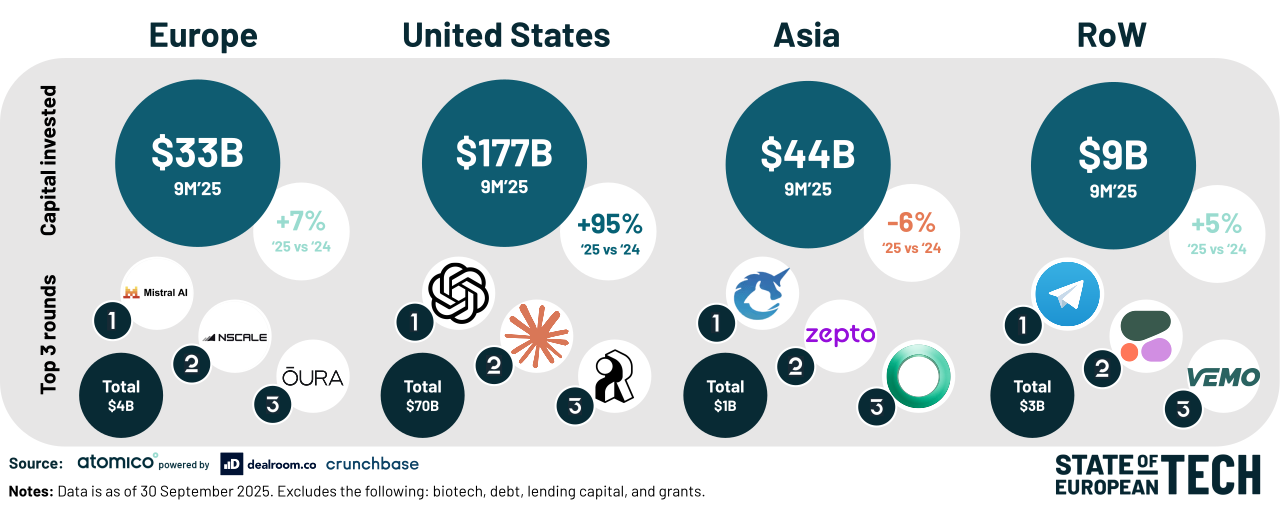
It’s important to view European tech investment levels in the context of the global stage. 2025 has unquestionably been a year of US exceptionalism. Total private investment into US tech companies reached $177B in the first nine months of the year, almost double the level of the same period in 2024 and nearly on par with the 2021 peak. The US accounts for two thirds of all global private tech investment this year, driven largely by a remarkable concentration of capital flowing into a small number of private US AI giants including OpenAI, Anthropic, and xAI.

Beyond the US, however, investment patterns have been far more consistent. Europe, Asia, and the rest of the world all saw broadly stable levels of capital deployed, with year-on-year changes remaining in single digits in all three regions — an indication of markets that have moved steadily rather than surged, in contrast to the US.

Deep tech drives investment levels

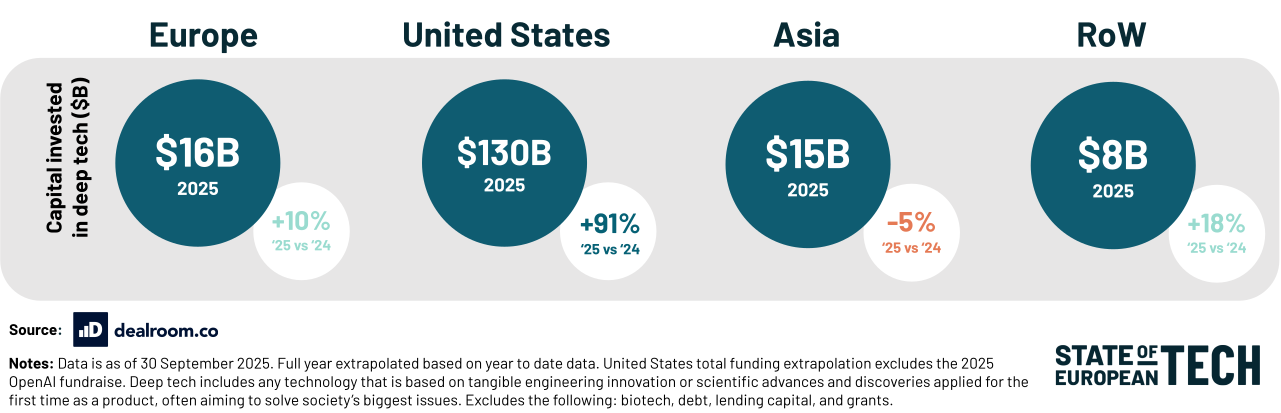
In 2025, 36% of European VC dollars went into deep tech companies, up from just 19% in 2021. The sector is producing standout moments — Helsing’s $660M Series D, Isomorphic Labs’ $600M raise after spinning out of DeepMind, or Proxima Fusion extending their Series A round to €200M.

Yet the overall scale still pales in comparison to the US, where rounds are routinely an order of magnitude larger. In the United States, OpenAI’s $40B ‘gigaround’ and Anduril’s $2.5B raise, with $1B alone coming from a single investor, illustrate the level of firepower available. Europe’s deep tech ecosystem is expanding fast, but capital intensity at this scale remains largely out of reach. 

That gap matters because tech follows power law dynamics, where a small number of outliers generate a disproportionate share of impact, jobs, and returns. To compete, Europe must build capital markets fit for those dynamics. It needs to recognise, fund, and retain the companies capable of bending the curve. This means stacking capital behind winners.

In Europe, deep tech bets are diversified across different technologies

Where the US concentrates bets on a few colossal AI labs, Europe has, to date, diversified across compute, quantum, defence, mobility, and climate tech. In 2025, $63B was invested in just two US companies — accounting for nearly a quarter of global VC. Europe, on the other hand, deployed $16B across dozens of deep tech themes, diversifying the allocation of capital across a range of strategic technology areas, but not yet displaying the same scale of capital concentration. 

In September, NScale’s $1.1B Series B became the largest in UK history. This was not a traditional funding round, and represented more of a new form of strategic partnership designed to accelerate scale in AI. A Norwegian industrial asset manager, Aker ASA, brought energy and infrastructure, while NVIDIA and Dell added compute power, and Finland’s Nokia is on board as a strategic networking partner. Together, they signalled a coordinated effort to build a European AI infrastructure backbone. This shared characteristics with ASML’s strategic partnership with Mistral, anchoring the AI model maker’s $2B Series C round with a $1.5B commitment. Beyond these examples, many other European moonshot companies, such as Isar Aerospace, The Exploration Company, Paebbl or Iceye all raised sizeable funding rounds in 2025.

There is a Swedish, and European, sensibility that creates a unique, and uniquely competitive approach to innovation.

We understand capital efficiency and we’re motivated by having a positive impact on the world. There’s a deep pride in quality and collaboration which leads to great products, tight teams, and a strong startup culture.

We’ve grown Lovable with world-class European talent and shown that like-minded, ambitious teams in Europe can become global category leaders. Europe has everything needed to build generational, trillion-dollar companies, and we are determined to prove it.

Anton Osika

Founder, Lovable

European pension funds are underweight

The path to greater firepower for emerging European champions lies in unlocking access to its deepest pools of capital. While US pension funds typically allocate 0.03% of AUM to venture, European counterparts invest a fraction of that at 0.01%. This varies across European regions, from 0.023% in France & Benelux to a strikingly low 0.001% in the UK & Ireland. 

Matching US-level pension fund allocations alone could unlock an additional $210B for Europe’s venture ecosystem over the next decade. This will truly move the needle, but it's also clear that this alone, while necessary, is not sufficient. Europe must continue to mobilise its own capital to build deep, liquid, full-stack markets that can finance growth from the first cheque to IPO, and beyond. If not, the region’s strongest companies remain at risk of their ambitions being capped by shallow local capital pools or disjointed European listing venues.

💰 US pension funds invest

3x

more into VC than their European peers. European pension funds only invested 0.009% of their total AUM into VC in 2024, while US pension funds invested 0.028%.

Sources:

Global exits have started to pick up

Liquidity is improving, creating conditions for greater recycling of capital back into the European tech ecosystem, a critical prerequisite to stimulate future investment at greater scale and consistency. 

Global exit activity reached $608B in 2025, up sharply from $364B in 2024, and approaching 2018 levels. The US remained the global leader in exit activity, accounting for more than 50% of global exit value in 2025. 

As momentum returns, Europe has an expanding pipeline of exit-ready startups, already representing hundreds of billions in unrealised value, and positioning the region to capture a larger share of global exit outcomes, and improving overall liquidity in its capital and talent markets.

Global exit value ($B) and share (%) by region, 2016 to 2025

SOET Logo

Source:

Notes:As per S&P Global Market Intelligence (Quantitative Research & Solutions), as of 24 October 2025, for illustrative purposes only. M&A transaction value at acquisition announcement date and tech IPO market cap by first trading date. Includes only completed M&A transactions for 2016 to 2023, includes both announced and completed M&A transactions for 2024 and 2025. Excludes any terminated or withdrawn transactions.

Champion risk

Stepping up to procure the future

The whole ecosystem needs to lean in to back and partner with European innovation. Government bodies could help change the trajectory by increasing the share of public procurement targeting innovation. This is especially important for companies developing moonshot technologies with longer timelines, where government contracts can bridge the gap between proof-of-concept and wider market adoption.

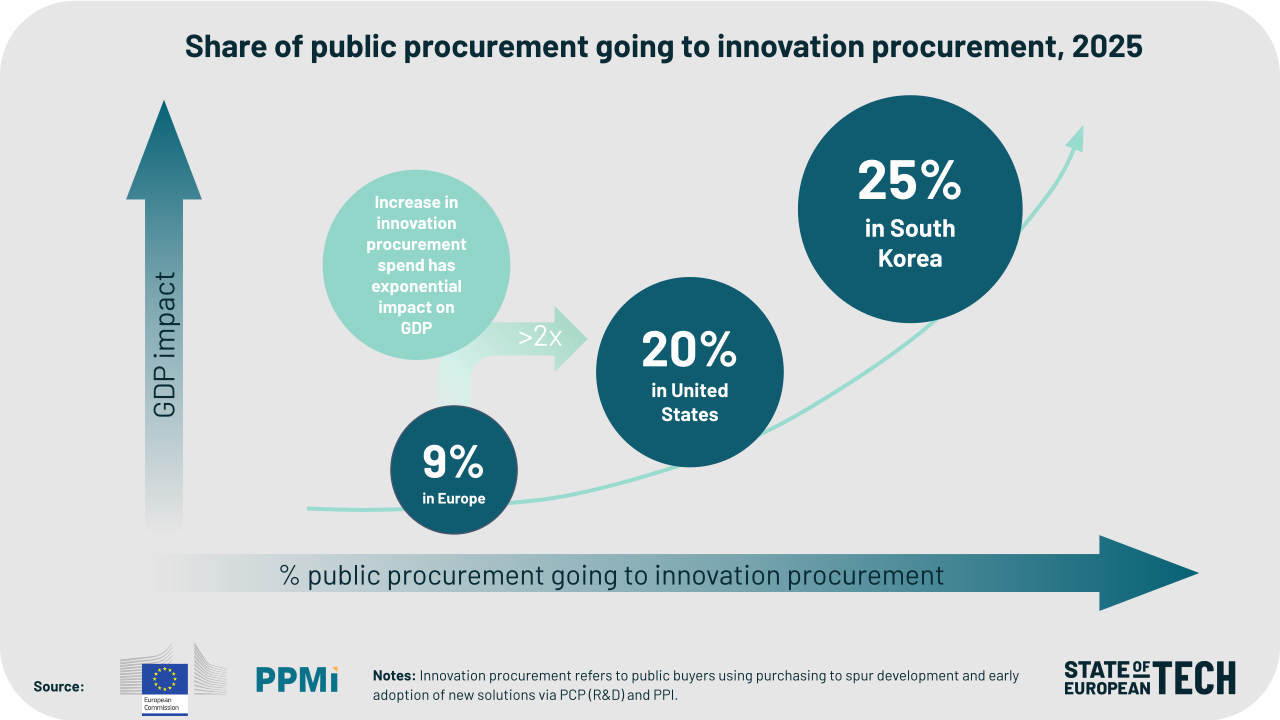
The data shows just how urgent it is to modernise procurement frameworks. Since 2021, just 9% of public procurement has targeted innovation in Europe — way off the 20% target the EU set itself in 2014. That’s money left on the table: studies showing that even a modest one percentage-point rise could lift GDP per capita by roughly €6k or 15%, while a five percentage point addition has the potential to add more than €45k, or in other words double GDP per capita.

Introducing Europe's Mighty 50

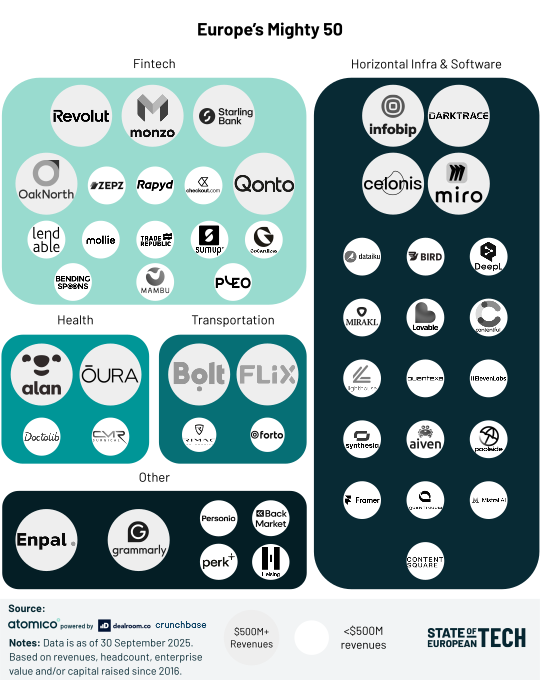
To understand which of today’s startups might become Europe's global strategic assets, we’ve identified a set of companies that are at breakout global scale and stand out across a few dimensions.

Tens of thousands of tech companies emerge each year, but only a handful go on to become era-defining companies like ASML, Spotify, or Stripe before them. So how can we spot which companies might be on that trajectory?

To answer that, we looked at companies founded since 2000 that have the most impressive revenue scale (median revenue is above $100M), are most valuable based on their latest round terms (the smallest being set at $2B), and are playing a significant role in shaping tech talent by employing at least 200 people (with some reaching 50x+ that level).

From fintech and enterprise software to food tech, transportation, health, and consumer tech, founders’ bold ambitions give many of these companies their edge.

These fast-growing businesses have already surpassed significant milestones in Europe — achieving significant revenue milestones, like Oura being on track to triple its revenues in 2025 to reach $2B in sales, or Revolut servicing 65 million customers and setting its sights on 100M+ in the near future.

European champions are going head-to-head on the global stage

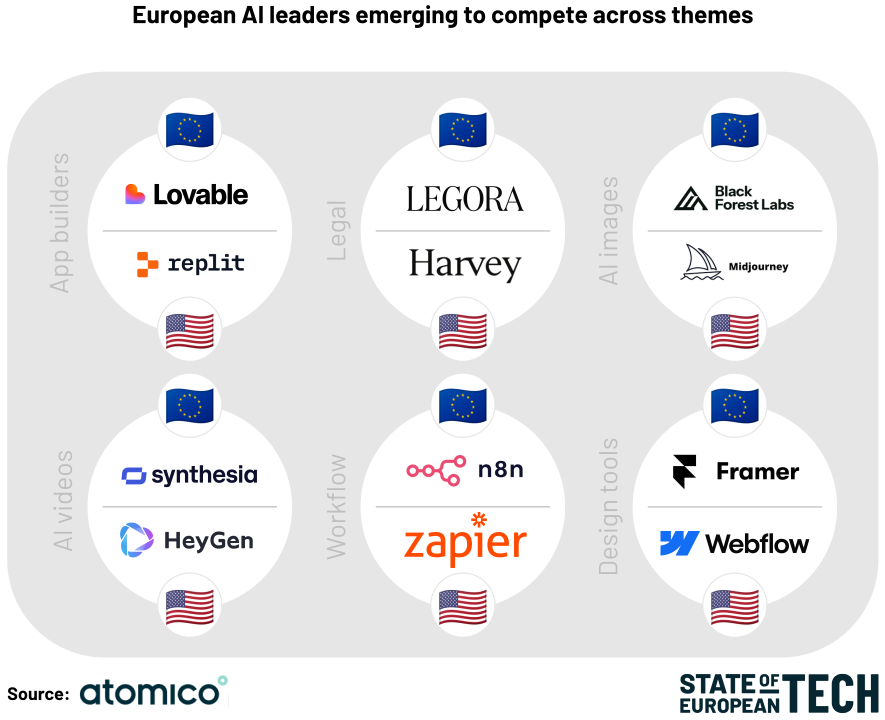
One of the most telling signals of Europe's potential can be seen in how its companies now compete head-on with global peers. AI leaders are emerging across multiple verticals, and they’re no longer described as the “European version” of an American success story. Lovable (Stockholm) and Replit (Silicon Valley) are both vying to dominate AI-powered coding platforms — and the former claims to have reached $100 million ARR faster than any software company before it, having got there in just eight months. AI workflow platform n8n is challenging Zapier in AI workflows, and Synthesia, the maker of AI video avatars often considered the gold-standard among enterprise AI video platforms.

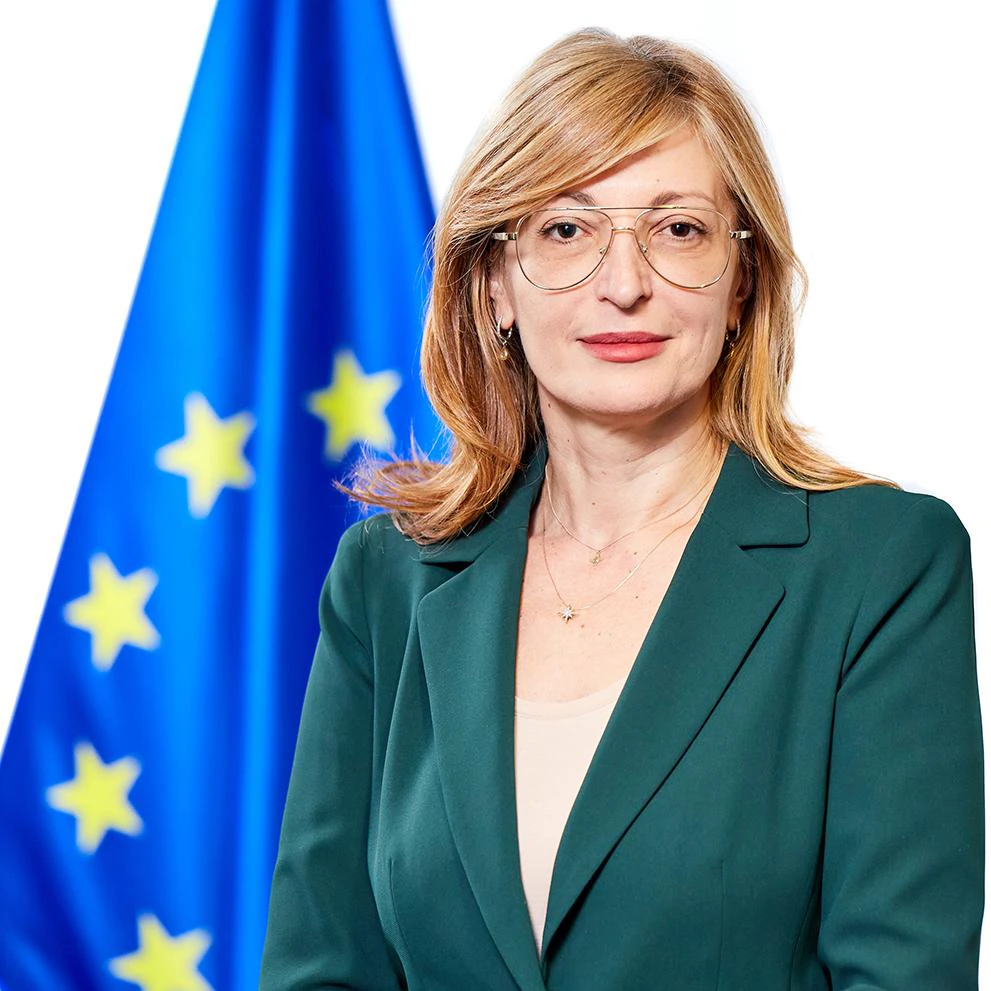
We must create the best possible framework conditions for innovators.

We must give them the opportunities they need to Choose Europe for developing their products and solutions, thriving in the Single Market and turning into global players.

Ekaterina Zaharieva

European Commissioner for Startups, Research and Innovation, European Commission

From vision to reality 

Europe must be the champion of its own story

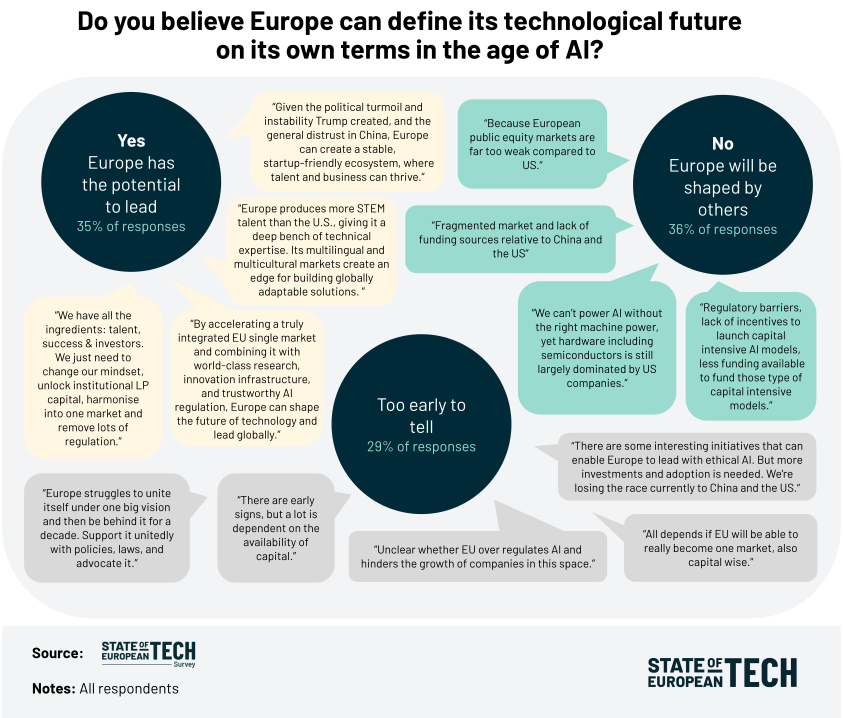
Can Europe write its own story in the AI era? On some level, it already is. Across a breadth of industries, companies are pushing boundaries and shaping the future. Europe is bringing its unique strengths to the table here, but although we have a story to tell, it’s far too often understated.

Our survey reflects this. Respondents are split on whether Europe can define its own technological future in the age of AI, with as many people saying yes as no, and the remaining 29% saying it is too early to tell.

Europe’s structural barriers to growth are real, but another risk is a wavering belief in the continent’s ability to support entrepreneurial vision — despite a rich history of industrial transformation and abundant global ambition that validate the continent’s role as a leader, not follower, of world-shaping innovation. 

Conviction in Europe’s ability to lead in AI is directly linked to optimism around the future of European tech as a whole. Those confident in Europe’s AI leadership are also the most optimistic in general, and the most pessimistic are the ones who don’t have faith in Europe becoming an AI power. Building AI leadership is therefore crucial for shaping sentiment, momentum and confidence in the broader European tech ecosystem.

Change is taking place

Europe’s tech ecosystem has reached a defining crossroads. To turn a decade of remarkable into enduring and accelerated global leadership, Europe must remove the structural barriers that still slow its builders down. These barriers begin at incorporation, persist through scaling, and linger in the public markets.

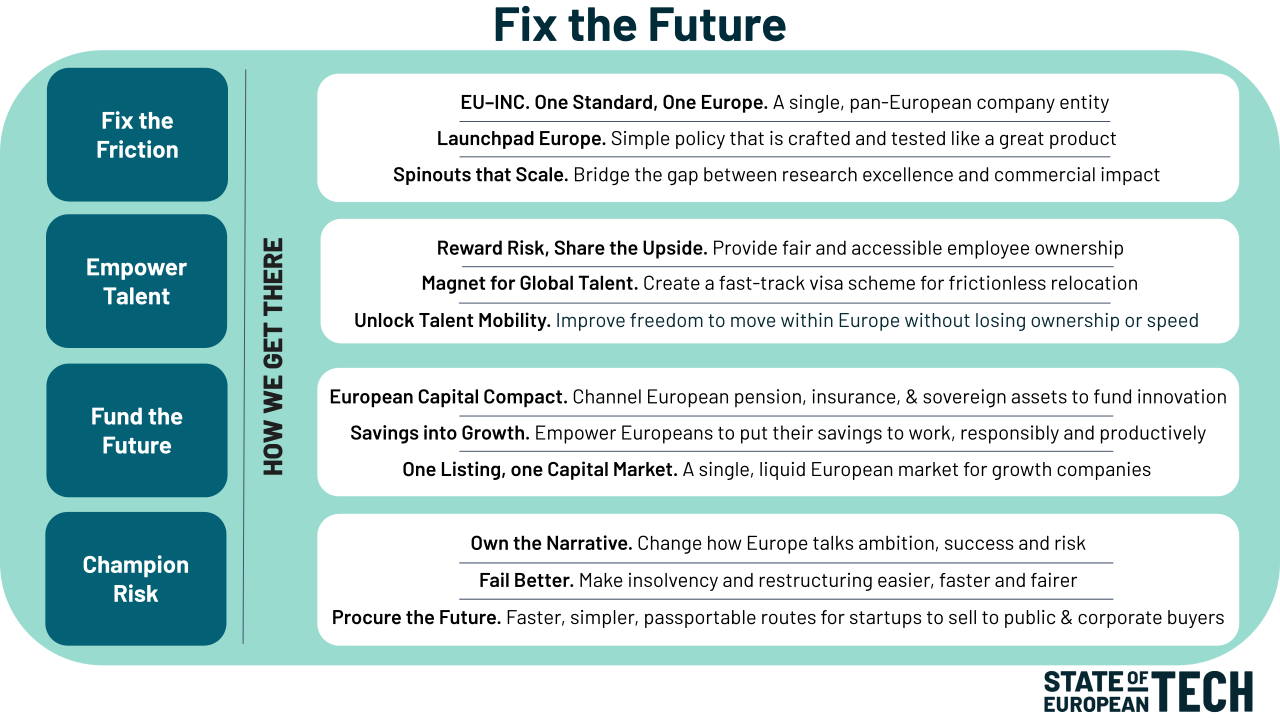
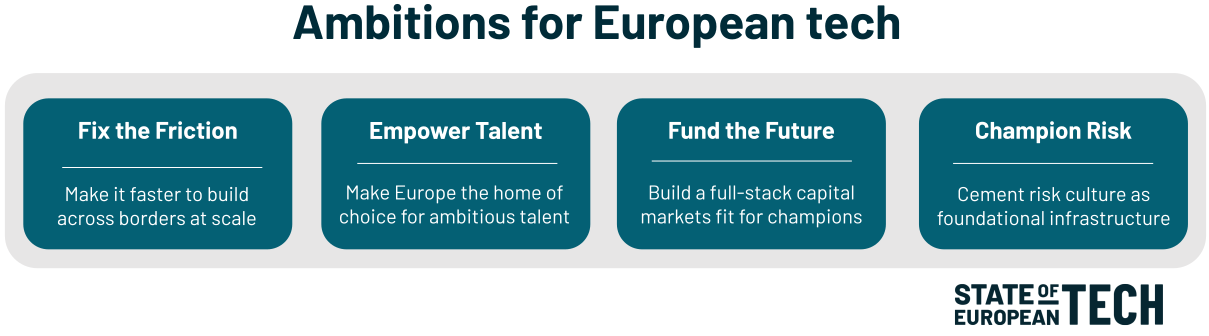
That’s why this year’s State of European Tech defines four missions — founder-first calls to action designed to align the ecosystem around the change required to make Europe the best place in the world to start, build and scale.

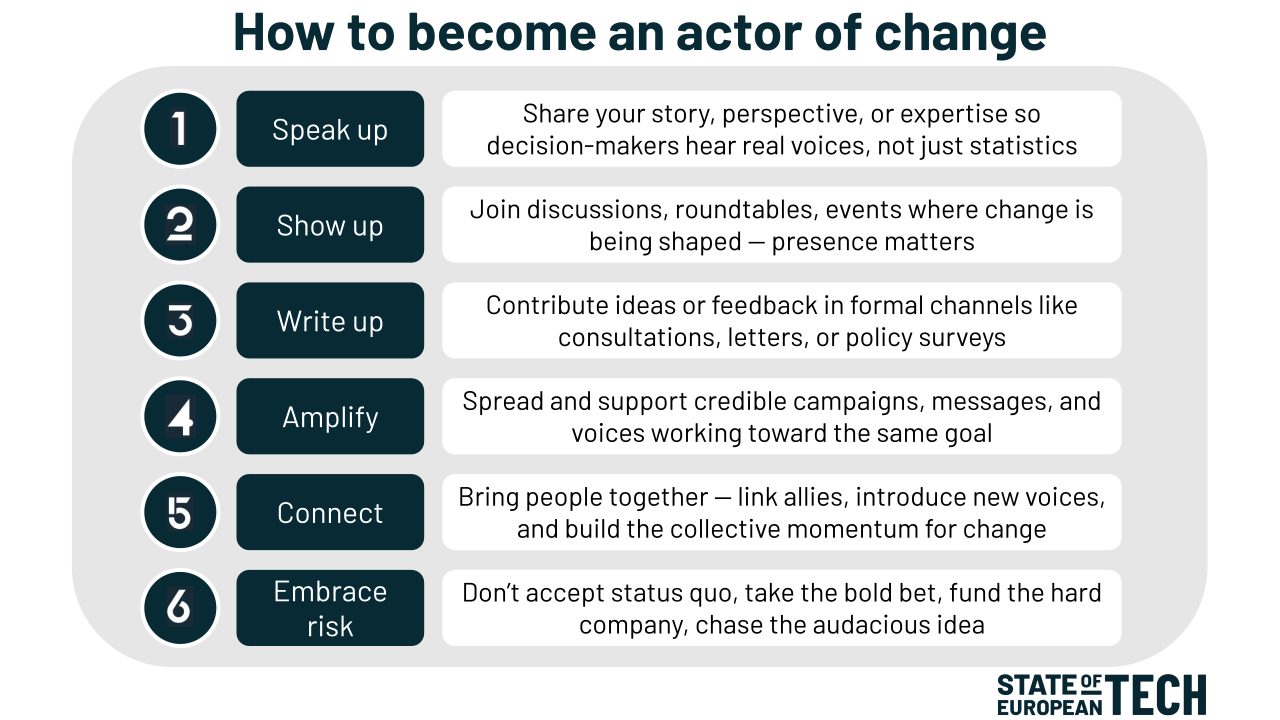
This is not trying to reinvent the wheel. The challenges - and how to solve them - are already well known or in active discussion. But by amplifying the ideas and shaping reforms already in motion, this work can rally founders, investors and policymakers around a shared agenda.

Turning talk into well-designed action delivered with speed, simplicity and scale will not happen by chance; it requires coordinated engagement across the ecosystem to ensure the right voices are heard and acted on.

To this end, the agenda has been simplified into four missions that capture where founder-first reform can have the greatest impact. Each mission focuses on known challenges and practical solutions - building on existing progress, amplifying credible campaigns, and accelerating ideas already within Europe’s grasp into action.

Together, they form a shared ambition to build an ecosystem that is faster, simpler, and more confident on Europe’s own terms - one that turns technology into shared prosperity and leadership for generations to come. Full commentary on each mission is detailed in the chapters that follow.

Political agenda for potential change is being set

The year ahead will be critical for Europe’s startups and scaleups. Building on 2025's Startup and Scaleup Strategy, the European Commission's work programme for 2026 includes a large number of major initiatives proposed at improving the operating environment for startups and investors, from the 28th Regime for Innovative Companies, to the European Innovation Act, from Savings and Investment Union, to new Acts for Quantum, Cloud & AI development and Advanced Materials, as well as long overdue reform of Public Procurement.

In theory, these are all aimed at improving the conditions for founders to build and grow in Europe. But, in practice, what will matter most is the design, delivery and execution of these proposals. European founders and investors have seen before how landmark regulation, from GDPR to the AI Act, was shaped in ways that left startups feeling like an afterthought, and burdened by unintended consequences. This time, the ecosystem has a chance to try and avoid this by engaging early and often, helping to set the right priorities, ensuring the measures truly solve real problems for startups and scaleups, and pushing for speed, simplicity, and focus in implementation. Europe’s startup ecosystem cannot afford to watch these initiatives take shape from the sidelines.

Overview of selected European Commission work programme initiatives for 2026

SOET Logo
InitiativeProposed timeline
28th Regime for Innovative CompaniesQ1 2026
European Innovation ActQ1 2026
Savings & Investment UnionQ1 2026
Cloud and AI Development ActQ1 2026
Public Procurement ActQ2 2026
Quantum ActQ2 2026
Update of the European venture capital funds RegulationQ3 2026

Source:

Notes:Based on the European Commission work programme 2026.

Mobilising support for founder-first change

Across Europe, a growing network of founders, investors, and ecosystem leaders are mobilising to ensure that the next wave of EU and national policy delivers real results for startups and scaleups. From campaigns like EU-INC pushing for a single pan-European startup entity, to Not Optional calling for modern stock-option reform, the community is organising to rally support for practical, founder-first change. Alongside these issue-specific campaigns, European networks such as Allied for Startups, the European Startup Network, and national organisations from France Digitale to Startup Coalition and Bundesverband Deutsche Startups are giving Europe’s startup community a stronger, more engaged voice in national capitals, Brussels, and beyond. By supporting their work and amplifying their campaigns, these initiatives and organisations offer practical ways to make an impact.

Selection of active issue-specific campaigns, national and European-level startups organisations

SOET Logo
TypeNameShort Description
CampaignEU-INCCampaign for a single pan-European startup legal entity (“28th Regime”)
CampaignNot OptionalCampaign to reform stock-option rules to attract and retain startup talent
CampaignEU AI Champions InitiativeCampaign to unlock Europe's full potential in AI

Source:

Notes:Email us at soet@atomico.com if you wish your organisation to be considered for inclusion.

EU–INC is a call by the startup ecosystem to policymakers to tackle a once-in-a-lifetime opportunity.

Europe’s multitude of countries is its unfair advantage – but also its weakness. Our startup scene is fragmented, with each country competing alone against the US and China.

EU-INC can change that. It’s an opportunity to unite our startup ecosystems under one continental vision. But it needs bold policymakers willing to build for startups, with startups. If done right, EU-INC could lay the foundation for a truly European tech ecosystem. In many ways 2026 may well decide Europe’s fate as an innovation powerhouse.

Andreas Klinger

Founder, PROTOTYPE Capital; Co-Initiator, EU-INC

Every individual action compounds across the community

Europe has the potential to be the best place in the world to start, build and scale a company. Simplifying the European operating system, improving access to capital at every stage, and building real liquidity are ambitious goals. However, even small, consistent actions across our community can add up to meaningful progress. Alongside these bigger objectives, we’re encouraging everyone in the ecosystem to play their part in supporting and championing European tech.

Next chapter →

Europe's Talent Engine

This chapter explores Europe’s deep and dynamic tech talent base — one which is expanding fast, rich in technical excellence, and driven by founders who see building in Europe as part of their mission. Optimism is returning and the entrepreneurial pipeline is stronger than ever, but scaling friction and perception risk remain real. The task ahead? Turn Europe’s talent advantage into an enduring global edge by making it the best place in the world to build and scale.