Next chapter →
SoET Community
Producing the State of European Tech is a team effort. We thank everyone across the tech ecosystem who spared their time, insights, and expertise so we could put together this year's report.

05
Europe’s innovation knows no borders. Once dominated by Consumer and Fintech, momentum is now shifting towards digital infrastructure, from data centres and semiconductors to security and energy. Sustained investment in strategic sectors like climate tech, AI, and defence will define Europe’s next decade. Yet ambition still outpaces commitment: growth-stage funding gaps and weak public procurement continue to hold back progress. Closing this 'commitment gap' by scaling investment in frontier technologies would turn strategic independence into Europe’s lasting competitive edge — and allow it to define the future on its own terms.
Tech innovation in Europe today extends far beyond the traditional boundaries of the “tech sector”. Over the past decade, digital technologies have seeped deeper into every corner of the real economy — from manufacturing and mobility to healthcare, agriculture, and defence.
As this has happened, the foundations of innovation have shifted. Europe’s funding landscape, once dominated by consumer tech, is increasingly tilting towards the infrastructure that powers this next wave — to AI models, semiconductors, clean energy systems, security, and compute infrastructure. These are the enabling layers that span sectors and use cases, upon which future breakthroughs will be built. Notable investments closed in 2025 include the $2B round announced by Mistral in September 2025, as well as the $1.1B Series B round announced by data centre startup Nscale. Fintech and horizontal infra and software (which also encompasses AI applications) have both seen their share of funding double since 2016. If the last decade was about SaaS “eating software”, the next decade will be about AI “eating industries”.
Further analysis also shows that capital is being concentrated into top deals across almost all industries — energy and fintech being the exceptions, with the largest energy deal coming in at $165M, raised by Swedish direct-to-consumer clean energy brand Aira. For fintech, the largest raise was fintech platform provider Rapyd's $500M Series F in March. Capital concetration is particularly stark in horizontal infra & software, where Mistral’s raise is 30x larger than any other round in the sector that took place in 2016. Security is also attracting significantly higher funding levels, having grown 4x over the past decade. In 2025, the largest round in this space was Helsing’s $660M; in 2016, it was Sirin Labs with just $72M.
Source:

🤖 The era of AI
31%
of all European funding raised in 2025 is going to companies building in AI / ML.
Sources:

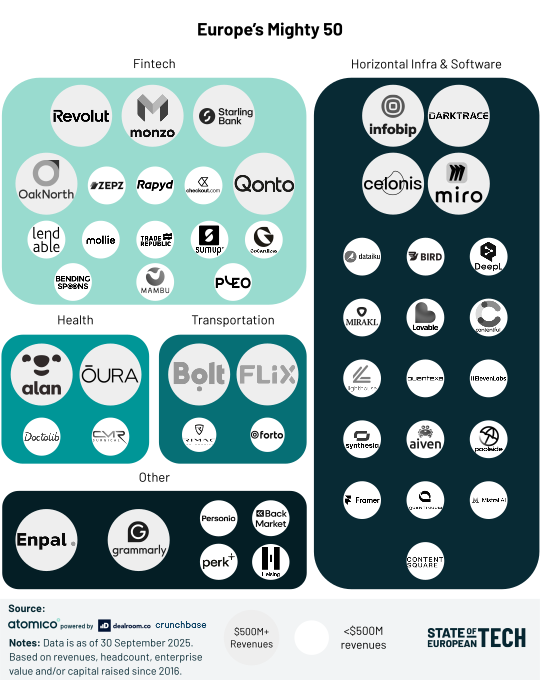
To understand which of today’s startups might become Europe's global strategic assets, we’ve identified a set of companies that are at breakout global scale and stand out across a few dimensions.
Tens of thousands of tech companies emerge each year, but only a handful go on to become era-defining companies like ASML, Spotify, or Stripe before them. So how can we spot which companies might be on that trajectory?
To answer that, we looked at companies founded since 2000 that have the most impressive revenue scale (median revenue is above $100M), are most valuable based on their latest round terms (the smallest being set at $2B), and are playing a significant role in shaping tech talent by employing at least 200 people (with some reaching 50x+ that level).
From fintech and enterprise software to food tech, transportation, health, and consumer tech, founders’ bold ambitions give many of these companies their edge.
These fast-growing businesses have already surpassed significant milestones in Europe — achieving significant revenue milestones, like Oura being on track to triple its revenues in 2025 to reach $2B in sales, or Revolut servicing 65 million customers and setting its sights on 100M+ in the near future.
The thematic flow of private tech investment tends to follow the innovation and entrepreneurial endeavours addressing the defining technological and societal priorities of each era. As compute intensity, climate urgency, and geopolitical competition reshape the global agenda, capital has increasingly concentrated around these themes.
Not surprisingly, generative AI model makers have scaled fastest, supercharged by accessibility and widespread adoption. The theme now attracts over 7% of all global funding, up from none back in 2016.
Climate tech related themes remain high on the agenda, with electric mobility (2.5%), circular economy (2.5%), and green buildings (1.6%) all breaking into the top 10. We can expect sustainability themes to continue to attract investment as they move from experimentation to larger-scale deployments.
Source:

We have a supportive policy environment. We have an amazing scientific community. We have more and more talent that is world-class at Industry 4.0 and building technology. And we have features in the European ecosystem that make it a very stable environment to build. So this was definitely our choice number one.
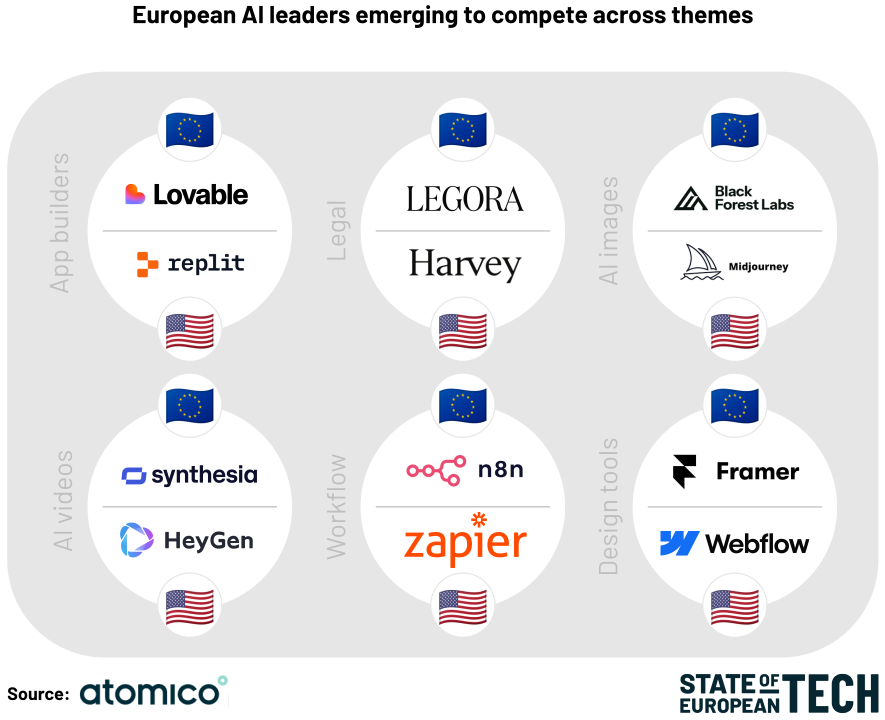
From developer tools to creative platforms, European AI companies are proving they can lead on the global stage across all themes.
Take Lovable and Replit, two rapidly scaling AI coding platforms — the former from Stockholm, the latter from Silicon Valley. While both are competing to define the future of building software, Lovable’s trajectory suggests Europe is not simply keeping pace but setting the bar: in just eight months, the company hit a $1B+ valuation and became the fastest software firm ever to reach $100M in ARR.
Other European AI companies poised for global market leadership include AI workflow platform n8n which is competing with the US’s Zapier, and Synthesia, the maker of AI video avatars often considered the gold-standard among enterprise AI video platforms.
Europe is home to some of the most ambitious AI companies of our time, but does it have the infrastructure to support them on their journeys to world domination?
We’re not just talking about funding, but GPU clusters; the physical backbone needed to distribute what will soon become as essential a resource as water or electricity — compute.
The US is currently home to most of the world’s GPU clusters, accounting for 75% of the global total compute in H100 equivalents. Europe hosts only 7%, and China 12%. As demand for compute drives construction of supercomputers around the world, innovators are turning their focus to the infrastructure itself, figuring out ways to make them more efficient, both to reduce environmental impact and ease pressure on ageing energy grids. Others are rethinking chip design altogether, such as Axelera, a Dutch startup creating AI chips that accelerate workloads while using less energy and generating less heat. This is happening in parallel with the emergence of well capitalised European next-gen compute players, like Nebius, Nscale or Domyn, all going after the AI compute opportunity at speed.
Today, the majority of Europe’s compute lies within Germany, Norway, France, Switzerland, and Finland, which account for over 70% of the European total. Germany already houses Europe's first European Exascale supercomputer Jupiter, and France is making major investments planning a $30B+ gigafactory financed in partnership with the UAE. Additionally, the EU has set up a €20B InvestAI fund to establish as many as five AI gigafactories, to fuel Europe's growing startup ecosystem.
As the race for compute is heating up, more commitments will be needed to power Europe's future. Europe needs to ensure more capacity, but also that it is competitive in terms of performance, cost, and accessibility to create options for the most ambitious AI companies to train and deploy on European compute.
Source:


With data, talent, and infrastructure rooted in Europe, they can innovate and scale quickly while maintaining control of where and how they build. To support that ambition, AWS continues to expand local infrastructure through new Regions and the AWS European Sovereign Cloud, and to make services such as Amazon Bedrock AgentCore available in-region giving founders the performance, proximity, and trust they need to move from experimentation to production.
‘Sovereignty tech’ has emerged as one of Europe’s defining ambitions, yet its meaning is often vague or misunderstood. Too frequently, it’s reduced to questions of data control or platform ownership. In practice, sovereignty in European technology should be defined by securing agency and optionality — building the capability, confidence, and capital to shape the future, while retaining the freedom to act independently and partner on Europe’s own terms.
In that context, Europe’s future shouldn’t be built on imitation or isolation, but instead on winning through innovation and performance. This isn’t about forcing a ‘Eurostack’ at all costs. The experience of Gaia-X, the EU’s federated cloud project that has struggled to deliver tangible results, demonstrates the limits of purely defensive approaches. Competing globally requires doubling down on what Europe already does best while staying pragmatic about using the best technologies available, even if they originate elsewhere.
The goal is not to replicate global giants but to create our own strategic global assets, technologies so advanced and essential that they give Europe real leverage in shaping the future. ASML is the clearest example today. It’s a company whose technological leadership underpins the global semiconductor industry and gives Europe true systemic influence. But Europe needs more ASMLs, and that means taking bigger bets on the next generation of outliers. This requires a combination of founders building at the frontier of science and technology, supported by investors and customers willing to back them with conviction, patience, and scale.
Europe’s greatest opportunities lie where strategic strength meets technological depth — in energy, industry, healthcare, science, defence, and AI.
Across these sectors, new European champions are emerging. Helsing is redefining defence through AI. The Exploration Company is rewriting Europe’s role in space. Proxima Fusion is pushing towards clean and abundant energy. IQM is bringing quantum computing into the mainstream. There are many others in satellites, robotics, cybersecurity, and compute.
Together, they point to what sovereignty really looks like in practice — not protectionism, but ambition. Europe’s strength will come from bold founders building technologies the world comes to depend on.






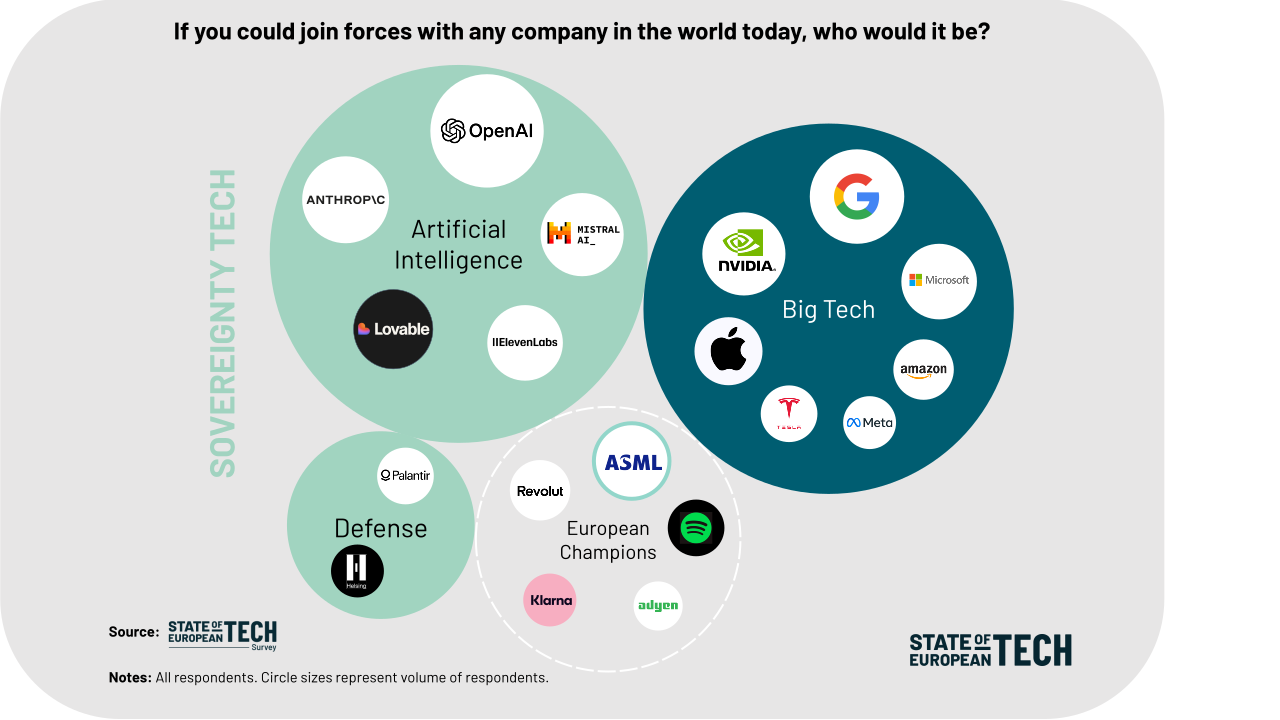
When we asked founders which company in the world they would most want to partner with, their answers spoke volumes about where power lies today. The overwhelming pull is toward Big Tech and AI hyperscalers — Google, Microsoft, NVIDIA, OpenAI — the companies that are today the dominant leaders in infrastructure and AI, and which represent the strongest sources of power and leverage.
A smaller number of respondents highlighted European champions, but they understandably command less mindshare in a world where respondents are, in effect, attracted by said power and leverage. Companies such as ASML, Helsing and Mistral stand out as symbols of Europe’s emerging capability to build the strategic global assets of the future.
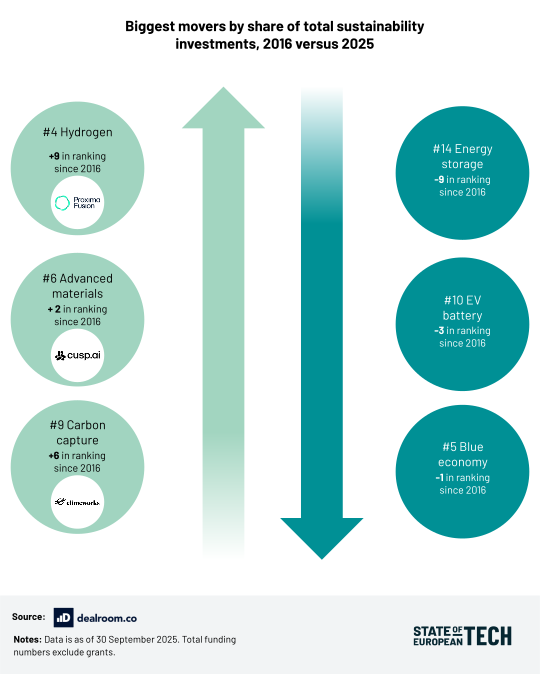
Europe leads the way with its continued commitment to funding climate tech — which we define as technologies that improve the planet, such as energy, carbon management, agritech, and more. This has become even more vital in recent years, with energy security now top of mind at an intergovernmental level following the Russia-Ukraine war, which spiked gas and energy prices in Europe.
In 2025 so far, 18% of all VC dollars invested in Europe went to planet positive companies. This is down from 2023’s peak, when sustainability linked investments made up a 32% share in Europe.
China has been the closest competitor to Europe's lead for the past few years, driven by their heavy investments in solar panel and electric vehicle technologies, often with participation from China’s government venture capital funds. Facing a changing macro and political backdrop, the share of these has been in decline since 2023, coming down to be on par with the US and rest of world.
Sources:
Ambition levels are scaling when it comes to delivering sustainability in Europe. Where we used to see carbon accounting companies dominate the funding landscape, we are now talking about a breadth of technological solutions spanning fusion, clean energy, batteries, and other high-tech solutions to fix the world’s biggest challenges.
These are the strategic technologies that will be essential for making a cleaner world a reality. Without carbon capture, which has risen six places in the top sustainability themes rankings since 2016, industrial-scale decarbonisation is a non-starter. Without hydrogen, up nine spots in the rankings, abundant carbon-free energy remains out of reach.
This shift is reflected in the notable deals now taking place in this theme, which include a $150M Series A raised by German fusion power plant designer Proxima Fusion, and a $100M raise from CuspAI in September. The company is using AI to create advanced materials, a theme that has risen two places in the rankings since 2016.
Local defence champions are vital for Europe’s geopolitical sovereignty, and VCs and founders are leaning in, encouraged by government pledges to ramp up spending. In keeping with broader investment level trends, Europe leads globally on share of funding in smaller, early-stage rounds, but captures a much lower percentage of larger, growth-stage rounds.
A war on European soil and rising geopolitical tensions have highlighted the urgency of European tech sovereignty, and focused the minds of investors and founders working in the defence sector. EU government pledges to spend an additional €800B on defence by 2030, along with defence budgets rising to as much as 3.5% of GDP across Europe, have created a rapidly expanding market and bolstered the investment case.
While overall funding levels saw a small year-on-year rise in 2025, investment in defence startups surged. The sector has attracted $1.6B so far this year, up from around $1B in 2024 — a 55% jump already before full year figures close, and well above any level of investment this theme has seen in the past decade in Europe.
Helsing’s mega round, which accounted for roughly a third of all European defence tech funding raised so far in 2025, shows how both builders and investors see the potential for next-generation technologies to transform the defence sector. The German company is applying AI to the battlefield, using its Lura model to power drones and submarines. Other large rounds for 2025 include Quantum Systems ($176M), Isar Aerospace ($165M), Cambridge Aerospace ($100M) and Roark Aerospace ($75M), while the past 18 month has seen Helsing, and unmanned drone makers Tekever and Quantum Systems, pass the $1B+ valuation milestone. In addition to generalist funds active in the defence space like Eurazeo, Plural, and Cherry Ventures, there is also a new breed of specialist investors emerging to back European defence — take, for example, Keen Ventures raising its new €125M fund.
Sources:
What kind of defence technologies are European investors backing?
By splitting the data to look at the share of capital invested per technology, we can see a showcase of European innovation, with a breadth of solutions that tech companies are developing. AI x defence has become the dominant segment of defence tech in the 2020s, representing 41% of all investment so far in 2025 — a sharp rise from just 4% in 2016. The majority of this year’s total comes from Helsing’s $660M raise.
Other notable deals include Quantum-Systems' $165M round, part of UAVs and UGVs, $165M for Isar Aerospace whose technologies fall under the space and satellite category, and Cambridge Aerospace's $100M, which sits under weapons / defence systems.
Source:
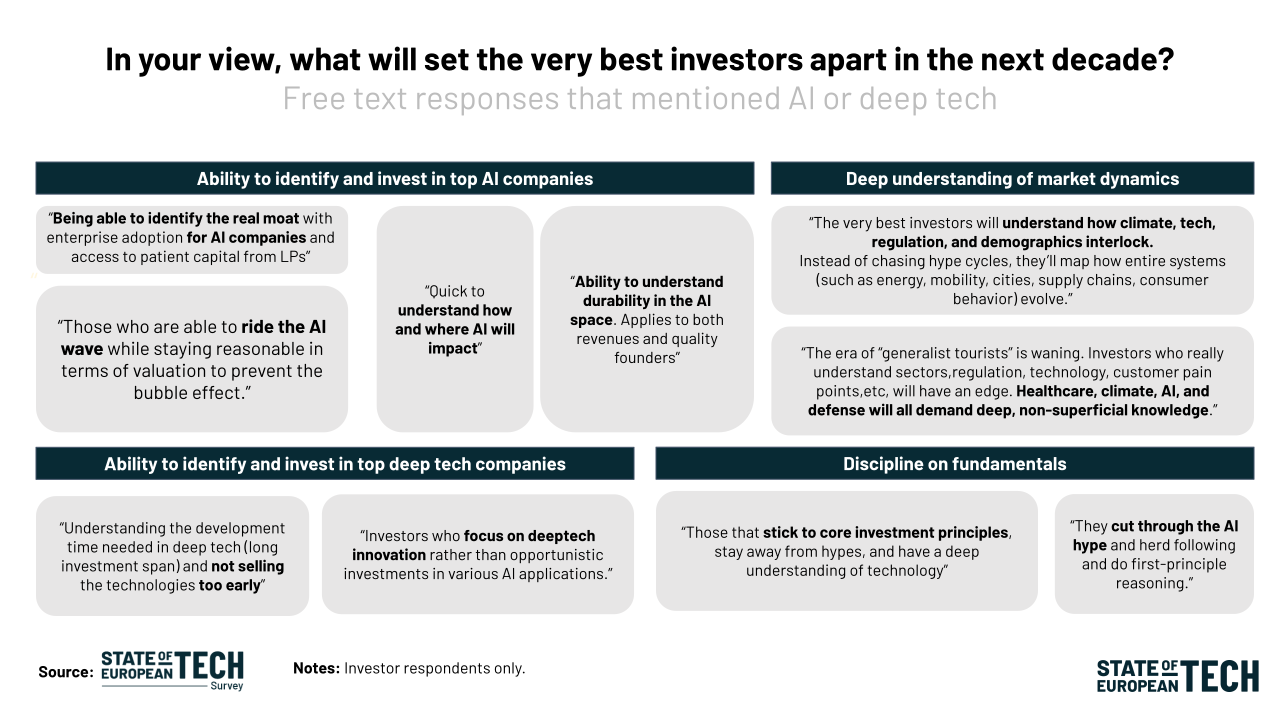
In the everything-is-AI era, the ability to understand which opportunities have real commercial potential, and which are unlikely to move the needle, will be key for investors.
Among investors who mentioned AI or deep tech when asked what will differentiate the best in their field over the next decade, 44% said a deep understanding of market dynamics. Top investors will “cut through the AI hype and herd following and do first-principle reasoning,” one respondent told us, while another said: “Instead of chasing hype cycles, they’ll map how entire systems (such as energy, mobility, cities, supply chains, consumer behaviour) evolve.”
Thirty percent of responses mentioning AI or deep tech also noted that discipline on fundamentals — such as coming to reasonable conclusions on valuations and understanding the metrics on which to best assess deep tech business models — will be another important quality for investors. An ability to leverage AI in their own work will be important too, like using AI to screen potential investments and predict future outliers, as cited by 19% of respondents.
Source:
As interest in topics like deep tech and AI continue to surge, investors believe that the GPs who are able to cut through the noise and make investments based on rigorous selection will emerge ahead of others. Here's what our survey respondents told us.

The peanut butter and chocolate combo for a deep tech board member is to have technical depth sufficient to actually understand the novel technology, a decade of experience building relevant products, and the empathy for what it takes to do this as a small start-up. None of this can be read in an MBA textbook or derived from a spreadsheet. The best deep tech founders aggressively seek out people who can accelerate their ability to make durable decisions and see around corners. As alluring as shiny brands, networks of downstream investors, and political connections can be, nothing can compensate for the raw ability to be a meaningful thought partner to a deep tech founder transforming their novel technology into a first-of-a-kind product — and eventually, a globally dominant business.
Deep tech is increasingly being seen as where the most strategic innovation bets lie, and funding levels have risen rapidly over the past four years as a result. In 2025, 36% of European VC dollars were invested in deep tech companies, compared to just 19% in 2021.
The largest rounds in Europe include Mistral’s $2B Series C, Helsing AI’s $660M Series D raise, and the $600M raised by drug discovery company Isomorphic Labs in its first funding round since spinning out from Google’s Deepmind.
Sources:
The US wins when it comes to the overall amount of VC dollars invested in deep tech at $130B to Europe’s $16B, but Europe holds its own at the earliest, Pre-Series A stages. In fact, Europe has been in joint first place with the US here for the last three years.
This could suggest the continent is quietly amassing a significant pipeline of potential deep tech champions. However, it could also be explained by the fact the US is making bolder bets from the get-go, a pattern we are also seeing emerge in Europe. Take for example Isomorphic Labs, which raised $600M in its first funding round, skipping the smaller raises many companies accumulate first.
Bridging the growth-stage funding gap will be crucial for enabling these early-stage companies to scale into global players, and strengthen Europe’s position in the race to become the next AI superpower.
Sources:
AI investment has surged globally, but the scale of US capital deployment is in a league of its own. In 2025, the US is set to invest around $119B in AI — more than 10 times the total private investment in either Europe or China. Much of this wave is concentrated at the infrastructure layer, where vast sums are being poured into the build-out of advanced compute capacity and the training of frontier models that underpin the next generation of AI capabilities.
By contrast, Europe’s investment profile looks very different. Far less capital has gone into infrastructure and generalised, foundational models, and far more into applied and full-stack vertical AI in areas such as autonomous vehicles, healthcare, or industrial automation, where AI is embedded directly into products and workflows. This reflects both a constraint and a strength. Europe’s ecosystem operates at a smaller scale, yet it competes with real breadth, focus on tangible deployment, and deep domain expertise rather than pure model competition.
Despite the vast gulf in relative investment, there are now signs of acceleration in Europe’s AI infrastructure. Projects such as Nebius, Nscale, and Domyn are building high-density GPU clusters and European AI capacity at speed and scale, while Mistral’s unprecedented raise adds further momentum.
Additionally, Europe is also proving that state-of-the-art performance doesn’t always require the same magnitude of investment. Companies such as ElevenLabs, DeepL, and BlackForest Labs are demonstrating that world-class AI products and performance can be built in Europe with frontier research foundations, efficient architectures, and pragmatic scaling strategies. Together, they show that Europe can exploit genuine competitive advantages in combining scientific excellence with real-world application.
Sources:
Europe’s AI landscape is expanding fast in the creation of commercially scaled, globally-relevant companies. From foundational model makers to applied AI specialists, a new generation of European firms is competing across the AI stack.
At the frontier, Mistral has become Europe’s most valuable AI company, while DeepL, ElevenLabs, and Synthesia have each defined new global benchmarks in language, voice, and digital media. Wayve is pushing the limits of embodied AI and autonomous mobility, and Domyn is building AI gigafactories to power models for defence, finance, and advanced manufacturing.
This new wave also reflects Europe’s geographic diversity. From Stockholm and London, to Paris, Milan, Heidelberg, Freiburg, Delft, or Copenhagen, world-class AI innovation is emerging across the continent.

Total raised: $2.9B

Total raised: $1.7B
Total raised: $1.3B
Total raised: $764M
(including $377M in debt)

Total raised: $641M

Total raised: $626M
Total raised: $550M
Total raised: $400M
Total raised: $281M
Total raised: $266M

Total raised: $223M

Total raised: $212M

France shows what is possible: world-class labs, vibrant founders, and growing investor confidence. The next step is alignment across Europe between capital, talent, and infrastructure, so ideas move from prototype to production faster. When those forces connect, Europe’s distinctive approach to AI will become its global advantage.
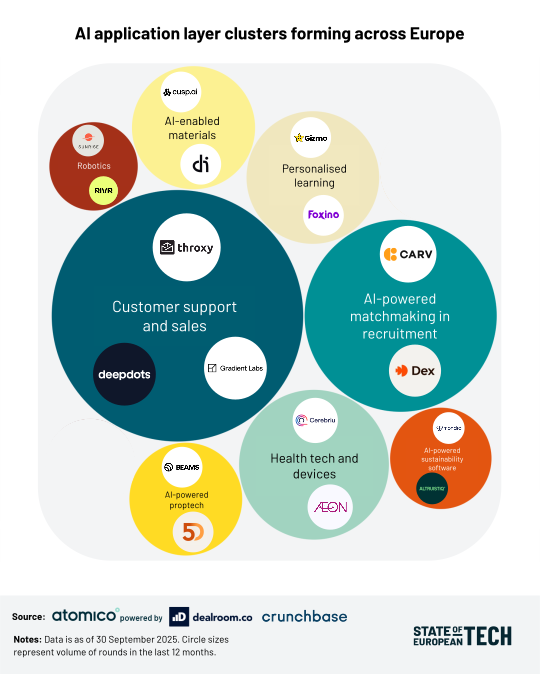
To find out what the next big sub-themes within AI are likely to be, we analysed how companies in the space describe themselves to see which ideas they are clustering around.
At the application layer — that is, the level where AI-powered tools are built for end users, downstream of the models themselves — founders are concentrating efforts on enterprise solutions for big and small companies alike.
A significant share of activity is happening in consumer support and sales — which features companies like Throxy, which helps book meetings with prospects, and Gradient Labs, which makes AI agents for fintech. AI-powered matchmakers for recruitment is another key cluster, with ‘zero admin’ recruitment platform Carv and AI talent matchmaker Dex among emerging European players.
More complex applications for sectors like healthcare, education and advanced materials are also gaining traction. Cerebriu is building AI-powered tech to make MRI scans more efficient, while CuspAI, fresh from a $100M Series C raise, is using AI to speed up the discovery of new materials.

It should come as no surprise that the region is now producing some of Europe’s most ambitious AI founders.
One of the most important ingredients for building the next generation of world-leading AI companies is the right talent. Europe is home to plenty of it with a rapidly expanding talent base, having grown at a 22% CAGR since 2016.
The old continent has long fostered world-renowned AI academic hubs — including Oxford University, the Max Planck Institute and ETH Zurich to name a few. Now, focus will need to shift to ensuring this amazing academic and research knowledge finds application in industry and, ultimately, commercial success.
Sources:

The gap in R&D spending between Europe and the US is driven less by appetite than by scale. In the US, tech giants sit alongside the world’s largest R&D investors, with companies like Amazon and Apple investing at levels that dwarf Europe’s entire tech sector. Apple alone spends more on R&D than the 10 largest European tech companies combined, while Amazon’s budget is more than three times that figure.
Yet relative to revenue, Europe is not far behind. Companies in both regions dedicate roughly 14% of sales to R&D, reflecting a similar level of commitment to innovation. The difference lies in structure: Europe simply lacks firms with the revenue scale of the largest US tech platforms, and its biggest R&D investors are concentrated in industrial and manufacturing sectors rather than in software and AI.
This matters because it shapes where innovation happens. Europe’s R&D base remains world-class, but too much of it is tied up in legacy sectors rather than digital infrastructure, compute, or deep tech capabilities.
Source:

Europe has a strong track record of modernising traditional industries through advanced automation and next-gen solutions. Europe is, after all, the continent that gave rise to the Industrial Revolution, swapping hand production for machines and bringing about a new era of growth.
In 2024, Europe installed 85k new industrial robots, compared to 56k in 2016. This underscores the region’s broad and sustained embrace of automation across manufacturing sectors and practical leadership when it comes to putting new technologies to work on the factory floor.
Still, on a global basis China remains far ahead, with installations tripling from about 97k in 2016 to more than 290k by 2024 — more than double the installations of Europe and the US combined.
Source:

The supply chain in this part of the world was quite limited as well. But that's evolved quite a lot I would say over the years. And I think the interesting part is also being based here in the UK. We have some fantastic addition industries that are really helping us with talent, with skills like automotive, obviously the military. It's quite an interesting hub when it comes to talents that you can easily bring over to the robotics side.
Innovative technologies need a clear path to commercial viability to succeed, but the clients who stand to benefit most can sometimes be the hardest to reach.
We consistently hear founders say large enterprises and public sector organisations are the toughest customers to win. Putting this to the test in our annual survey, 42% of all respondents say they have struggled to sell to large enterprises and 25% say the same for the public sector.
This validates that more efficient procurement processes could significantly move the needle for European tech, but bridging the gap between interest and action will require greater education on both sides. Founders will also need to show willingness to find new ways of building cultural buy-in within organisations that aren't as nimble as a tech startup.
Source:
🙈 European corporates shy away from startups
20%
of European corporates actively engage with startups — in stark contrast to 50% in the US.
Source:

Founders and operators building new technologies, products or services need customers who are open to sharing the risks (and rewards) of finding better ways of doing things.
In our survey, founders and operators said faster decision making and a greater openness to pilot projects would make it much easier to sell into large corporates or government bodies as complex technologies need a chance to show rather than tell customers their value. They also cited lighter-weight contracts, clearer points of contact, simpler procurement processes, and budgets that are explicitly dedicated to startups, with each selected by around 25% of respondents.
Interestingly, regulation barely registers as a concern here, with more standardised vendor requirements only getting 12% of the votes. This is likely because, even with the lightest regulatory burdens, progress still depends on corporates and governments being willing to try something new.
Source:
💻 European corporates and governments spend
$2T
per year on IT, mostly going to US vendors.
Source:

And certainly we have a lot of structural headwinds in front of us. But there has never been a more exciting time to build here in Europe and also to think of technology as a way to be able to recover growth, to find growth again, to find wealth again here in Europe.
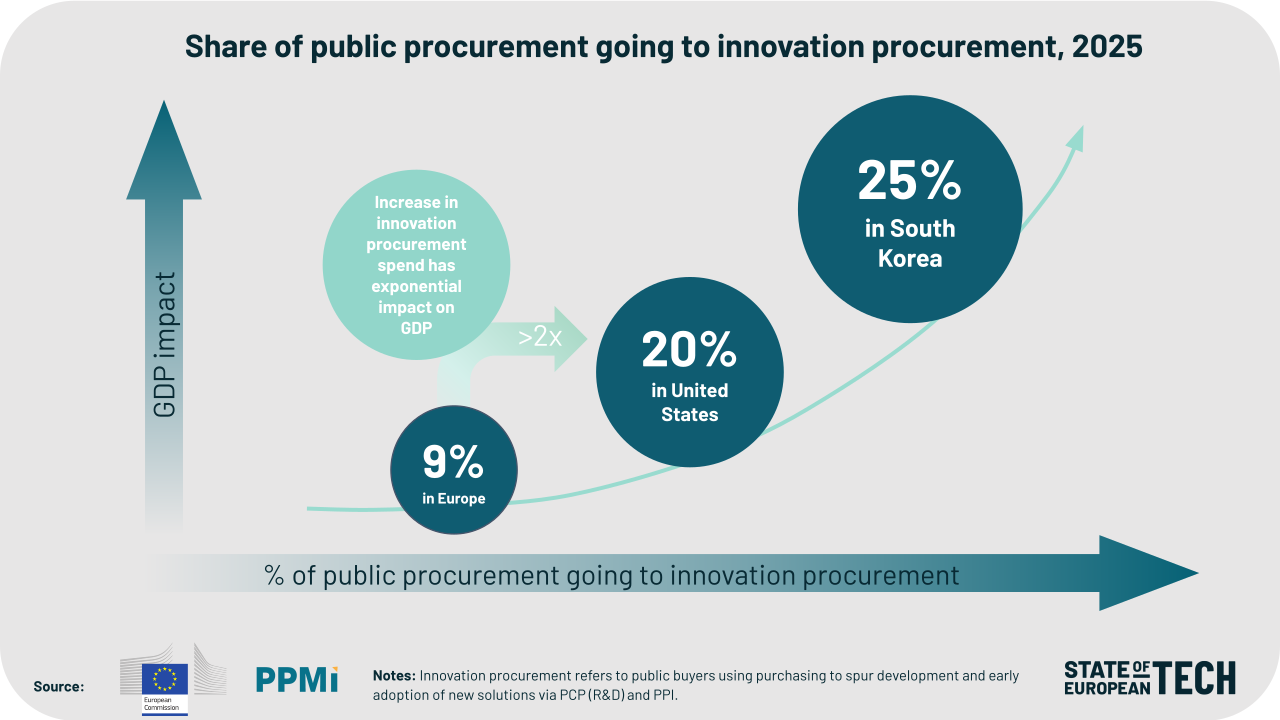
Public procurement is one of the most powerful tools governments have to stimulate innovation, but Europe has yet to fully use it. In 2014, the EU set a target for 20% of all public procurement to go toward “innovative solutions”. A decade later, the figure has stalled at 9%, well below the 20% level of the US and 25% in South Korea, a global leader in innovation-driven public procurement.
Public demand has always been a catalyst for private innovation, while the economic case for change is also clear. Increasing the share of innovation-focused procurement delivers exponential returns: even a one percentage-point rise could lift GDP per capita by roughly €6k or 15%, while a five percentage point addition has the potential to add more than €45k, or in other words double GDP per capita.
Yet without a clear and well-designed strategy that translates ambition into execution — and tackles the barriers preventing procurement at speed and scale — Europe risks leaving this multiplier effect on the table.
Not one European deep tech company founded in 2016 has passed the $500M funding milestone.
This is striking given Europe’s deep talent pool and ambitious founders, and is yet another reminder of the continent’s growth capital gap, which is particularly acute for deep tech companies given their capital intensive models. Companies founded since 2016 have exceeded the $500M funding milestone — Wayve, founded in 2017, raised $1B in 2024, while two-year-old Poolside raised $500M last year — but still not at a rate that is truly reflective of Europe’s innovation pipeline.
By comparison, 40% more deep tech companies founded in 2016 based in the US have crossed the $1M funding threshold, and the share raising over $100M is nearly three times that of European companies.
If European companies cannot get financing locally, this could be what pushes them to relocate — meaning Europe risks losing important pieces of local sovereignty tech in the process.
Sources:
Can Europe write its own story in the AI era? On some level, it already is. Across a breadth of industries, companies are putting their heads down and pushing boundaries, aiming to shape the future for the world, not just their own success.
Did you miss it? That could be because, even though it’s a story of ambition, it doesn’t come with the fanfare seen elsewhere. Think blockbuster fundraises in the US, or Asian tech firms suddenly exploding onto the market. Europe’s narrative is more understated, but no less ambitious.
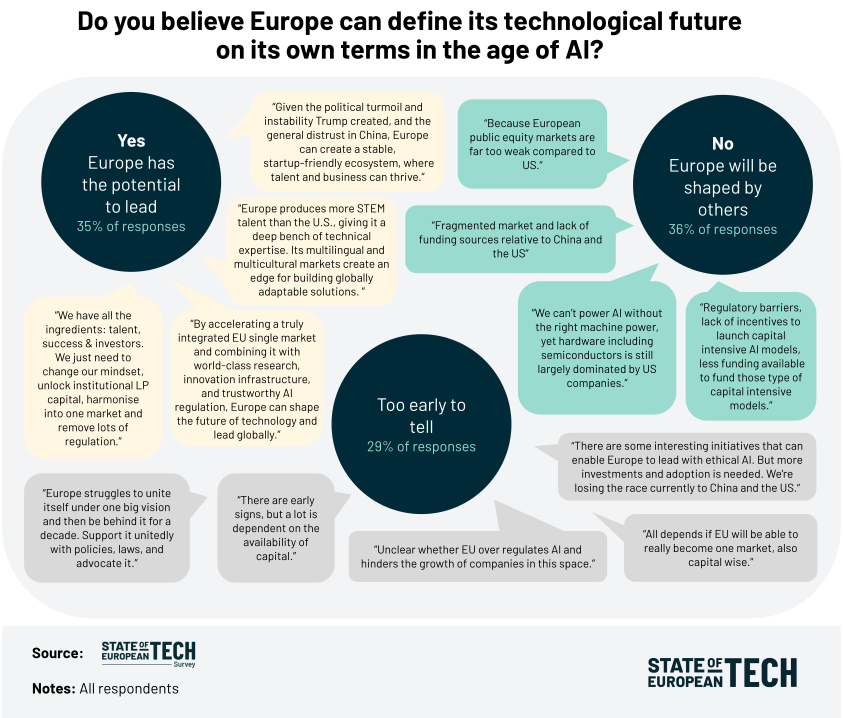
Our survey reflects this. Respondents are split over whether Europe can define its own technological future in the age of AI, with as many people saying yes as no, and the remaining 30% saying it is too early to tell.
Belief in Europe’s ability to lead in AI is directly linked to optimism around the future of European tech as a whole. Those confident in Europe’s AI leadership are also the most optimistic in general, and the most pessimistic are the ones who don’t have faith in Europe becoming an AI power.
Building AI leadership is therefore crucial for shaping sentiment, momentum and confidence in the European tech ecosystem.

Europe has all that it takes — the talent, the research ecosystem, the funding — and now needs to bring it together into startups, into organisations that can move very fast, and that can create new European technology giants and redefine the way the European economy works. We can do all of that.
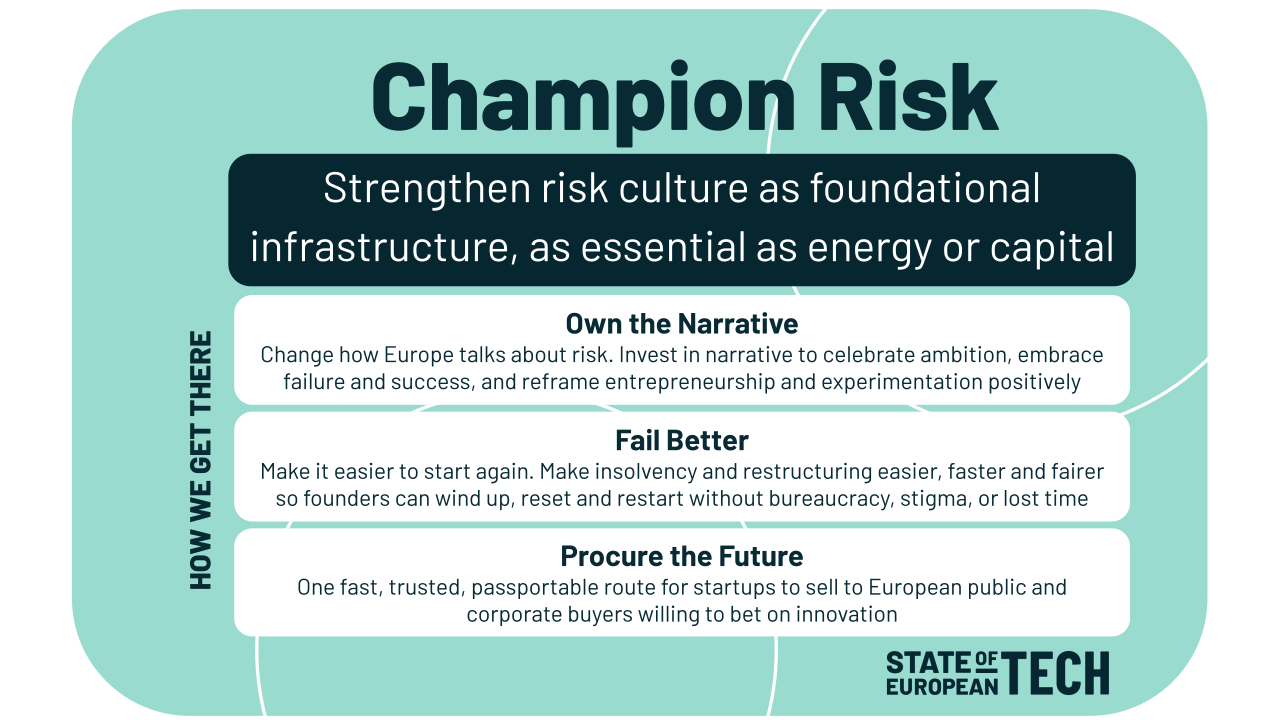
Progress doesn’t happen without risk. Every founder, investor and operator knows the moment of choice: Do I start this company? Quit my safe job? Bet on the crazy idea that might just work? Choose the innovative new startup’s product? Those who answer yes are the people who move Europe forward.
Over the past decade, that mindset has begun to take hold. Europe is building an entrepreneurial culture — bold thinkers and calculated risk-takers who believe that the regret of not trying outweighs the fear of failing. This shift is spreading across angels, venture capitalists, universities and operating talent — creating a more ambitious, resilient Europe.
Yet too often, risk is still managed away rather than rewarded. It’s always easier to play it safe. To take the steady job, stick with the incumbent product, or regulate risk away. Meanwhile, failure still carries stigma. Incentives to take bold bets remain weak. Progress too often waits for perfection or permission, extending decision-making timelines.
Only 20% of European corporates actively engage with startups, compared to 50% in the US, and just 9% of public procurement goes to innovation — less than half the US benchmark. Companies that win with European corporates and governments are the ones that win globally.
The challenge is clear. Europe must strengthen risk culture as foundational infrastructure, as essential to our future as energy or capital. Safety is essential, but responsible innovation doesn’t mean slowing down or not taking risks, it means building the right guardrails at speed, and treating failure as a system design feature, not a bug.
How we get there:
Championing risk means embedding courage into Europe’s DNA, moving fast safely, rewarding ambition, and proving that progress and prudence can coexist. Because belief is the ultimate currency of progress — when people believe in what’s possible, ambition flourishes and action follows.